

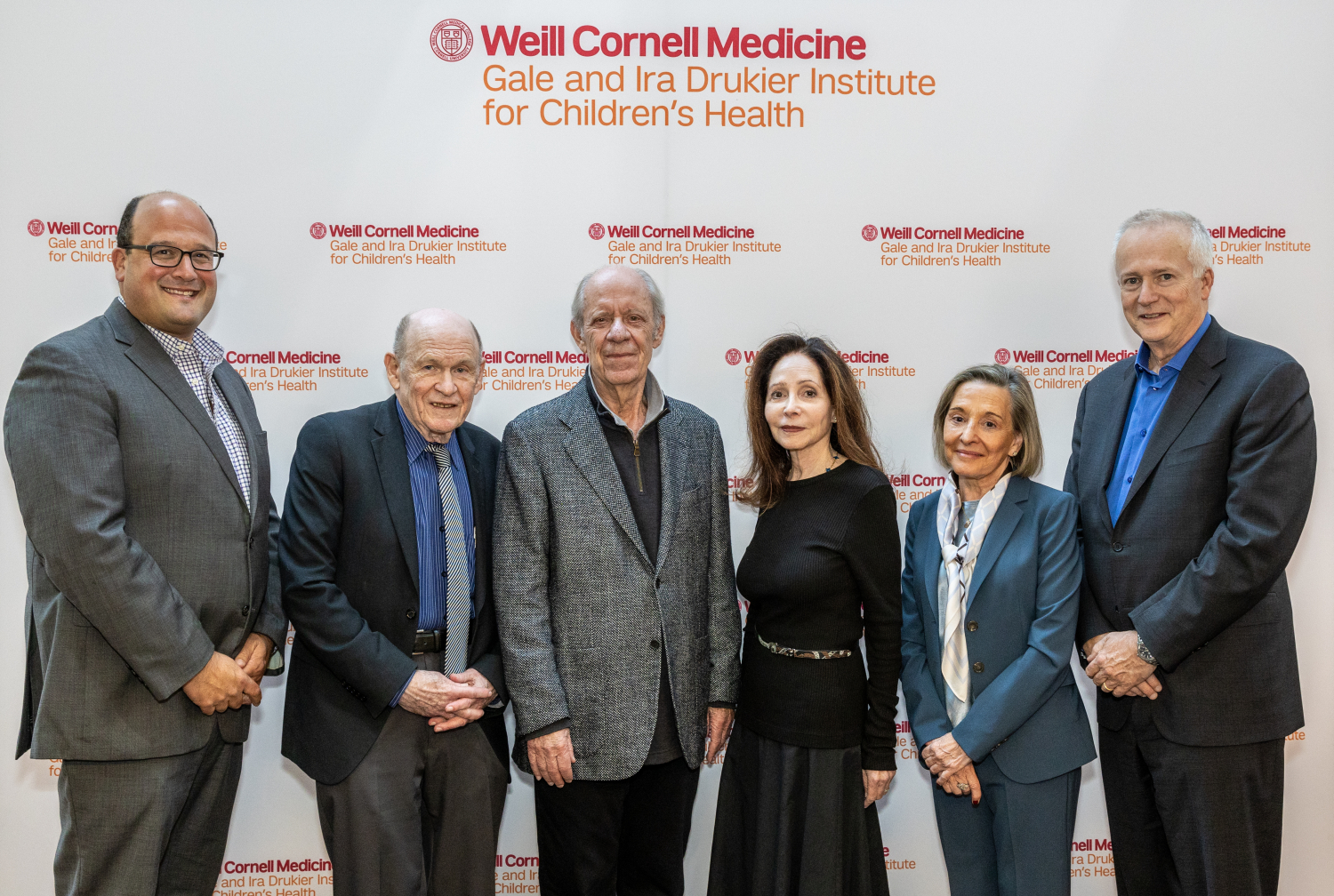
Dr. Robbie Majzner, an esteemed physician-scientist whose research focuses on children with intractable cancers, has been awarded the 11th annual Gale and Ira Drukier Prize in Children’s Health Research by Weill Cornell Medicine.
The Drukier Prize recognizes an early-career pediatrician whose research contributions have the potential to significantly improve the health and well-being of children and adolescents. Dr. Majzner is an associate professor of pediatrics at Harvard Medical School and a pediatric hematologist-oncologist at Harvard-affiliated Dana-Farber Cancer Institute/Boston Children’s Hospital.
He is being recognized for his research efforts to design better CAR T-cells, understand the cancer targets those cells attack and test the resulting therapies, particularly in children with solid tumors and cancers that develop resistance to existing treatments.
Dr. Majzner’s lab studies how CAR T-cells—genetically engineered immune cells programmed to recognize and destroy cancer cells—receive and transmit signals once they encounter a cancer cell. This understanding of how the engineered immune cells function has allowed his lab to reimagine how they are designed and deployed.
Dr. Majzner also focuses on advancing laboratory studies into clinical trials. He was part of a team that first discovered that a sugar found on the surface of cells, called GD2, is present at extremely high levels on diffuse intrinsic pontine glioma, or DIPG, a childhood brain tumor that’s almost universally fatal. After designing CAR T-cells to recognize GD2, they showed that these specialized cells were able to attack and eradicate the tumor in mice. Within four years of publishing those findings, he co-led a phase 1 clinical trial in which eight of the first 10 children treated with these CAR T-cells showed either measurable tumor shrinkage or clinical improvement.
Dr. Majzner received his award, which carries an unrestricted honorarium, and gave a presentation titled, “Utilizing Insights from Basic Biology to Engineer More Effective Immunotherapies,” at a ceremony on Oct. 13 in Weill Cornell Medicine’s Belfer Research Building.
Dr. Nahum Sonenberg, the Distinguished James McGill Professor and Gilman Cheney Chair in the Department of Biochemistry and the Rosalind and Morris Goodman Cancer Institute at McGill University, will deliver the Gale and Ira Drukier Lecture in Children’s Health. The lecture highlights research and discoveries that have contributed to remarkable advances in understanding and treating children’s diseases.
Dr. Sonenberg, whose talk is titled, “Dysregulated Translational Control in Brain Disorders,” has led pioneering research efforts to reveal how problems with cells’ protein production process can play a role in cancer, obesity, diabetes and neurological diseases. His work has also established links between the regulation of protein production and learning and memory, autism, and fragile X-syndrome, the most common inherited cause of intellectual disability.
The Drukier Prize and Lecture were established as part of a $25 million gift to Weill Cornell Medicine from Dr. Gale Drukier and Weill Cornell Medicine Board of Fellows member Dr. Ira Drukier in December 2014. The gift created the Gale and Ira Drukier Institute for Children’s Health, a premier, cross-disciplinary institute dedicated to accelerating research into the underlying causes of devastating childhood diseases.
“Dr. Majzner is a pioneering physician-scientist whose commitment to finding more effective treatments for children with life-threatening forms of cancer exemplifies the goals of the Drukier Prize,” said Dr. Robert A. Harrington, the Stephen and Suzanne Weiss Dean of Weill Cornell Medicine. “We thank the Drukiers for their extraordinary support and are gratified to recognize Dr. Majzner with this year’s award.”
“It’s incredibly rewarding to honor physicians and scientists like Dr. Majzner, who devote their careers to improving children’s lives,” the Drukiers said. “Dr. Majzner’s work offers an inspiring path forward for these young patients and their families faced with pediatric cancers, and we look forward to watching how his future efforts blaze a trail in this vital area of research and care.”
“Dr. Majzner’s innovative research studying CAR T-cells and the tumors they attack, and the resulting therapies he has tested, have the potential to make a lasting change in the field of pediatric oncology,” said Dr. Virginia Pascual, the Drukier Director of the Gale and Ira Drukier Institute for Children’s Health and the Ronay Menschel Professor of Pediatrics at Weill Cornell Medicine. “The Drukier Institute is delighted to be recognizing this critical work and the promise it has for children with these devastating cancers.”
“I’m thrilled to have been selected for this award in a very broad field across all types of children’s health, and proud because this aligns with my mission to use basic laboratory science and engineering to help kids with cancer,” Dr. Majzner said. “This honor also truly endorses that this career path is one that can be impactful for patients.”
Dr. Robbie Majzner
Dr. Majzner’s work has been funded by the National Institutes of Health, the National Cancer Institute, the Department of Defense and the Cancer Research Institute, among others. His research has also developed a new type of CAR T-cell that requires two different cancer markers to be present simultaneously. This approach allows T-cells to kill cells carrying both targets rather than a single target. He and his colleagues now want to apply this technology to glioblastoma and other difficult-to-treat solid tumors.
“Ultimately, I hope the therapies we invent in the lab help cure children of their cancers and do it with less toxicity than what is currently available—and become widely accessible to children anywhere,” Dr. Majzner said.
Dr. Majzner earned his medical degree in 2009 from Harvard Medical School. He then completed a pediatric residency at NewYork-Presbyterian Morgan Stanley Children’s Hospital and a fellowship in hematology/oncology at the National Cancer Institute and Johns Hopkins Hospital. He joined the faculty of Stanford University School of Medicine in 2016, rising to the position of assistant professor of pediatrics. In 2023, he was appointed associate professor at Harvard Medical School. He also serves as director of the Pediatric and Young Adult Cancer Cell Therapy Program at Dana Farber Cancer Institute/Boston Children’s Hospital.
Dr. Majzner is a member of the American Society of Hematology, American Society for Clinical Oncology, American Association for Cancer Research and the Advances in Neuroblastoma Research Association. He has received many prestigious awards, including the NIH Director’s New Innovator Award, the Cancer Research Institute’s Lloyd J. Old Star Award and the Pershing Square Sohn Cancer Prize.
Dr. Nahum Sonenberg
Dr. Sonenberg received his doctorate in biochemistry from the Weizmann Institute of Science in 1976. He then joined the Roche Institute of Molecular Biology in New Jersey as a postdoctoral fellow. In 1979, he became a faculty member at McGill University in Montreal. Dr. Sonenberg is an elected member of the Royal Society of London and an international member of the National Academy of Sciences, as well as a recipient of the Gairdner Award and Wolf Prize in Medicine. He was inducted into the Canadian Medical Hall of Fame in 2023.

