

Metabotropic glutamate receptors, which are important but difficult drug targets, interact in surprisingly varied ways with their principal regulatory proteins, according to two new studies led by Weill Cornell Medicine investigators. The findings represent a big step forward in understanding these receptors and how they can be targeted effectively to potentially treat conditions such as epilepsy, depression, and anxiety disorders.
Metabotropic glutamate receptors (mGluRs) are found on cells throughout the body and are especially important as modulators of synapses in the brain. Pharmaceutical companies have long sought to target them to treat a variety of neurological and psychiatric disorders. Those efforts have fallen short of expectations, in part because mGluR activity is naturally regulated—by proteins called beta arrestins—in ways that have not been well understood. In the studies, published Sept. 10 in Nature Communications, the researchers established the foundation for a much better understanding of these receptors, by revealing and visualizing a wide variety of mGluR-beta-arrestin interactions. The results should help researchers understand better why some previous drugs targeting mGluRs have failed, and how future drugs could target these receptors more effectively.

Dr. Joshua Levitz
“These findings are the culmination of years of work to characterize this amazing diversity of mGluR-arrestin interactions—a diversity that suggests a lot of complexity in how these receptors are regulated and points to new opportunities for precisely targeting them with drugs,” said study senior author Dr. Joshua Levitz, a professor of biochemistry and biophysics at Weill Cornell Medicine.
The first author of both studies was Dr. Dagan Marx, a former postdoctoral researcher in the Levitz laboratory.
Metabotropic glutamate receptors belong to a large class of receptors called G protein-coupled receptors (GPCRs). Researchers once believed that beta arrestins regulate and inhibit GPCR signaling in ways that are relatively simple and similar across all members of this class. However, recent studies, including by the Levitz laboratory, have begun to paint a more complex picture of these interactions. In general, researchers have come to appreciate that the precise physical details of GPCR-beta-arrestin interactions and their effects on cells are still unclear for a substantial proportion of these receptors, including mGluRs.
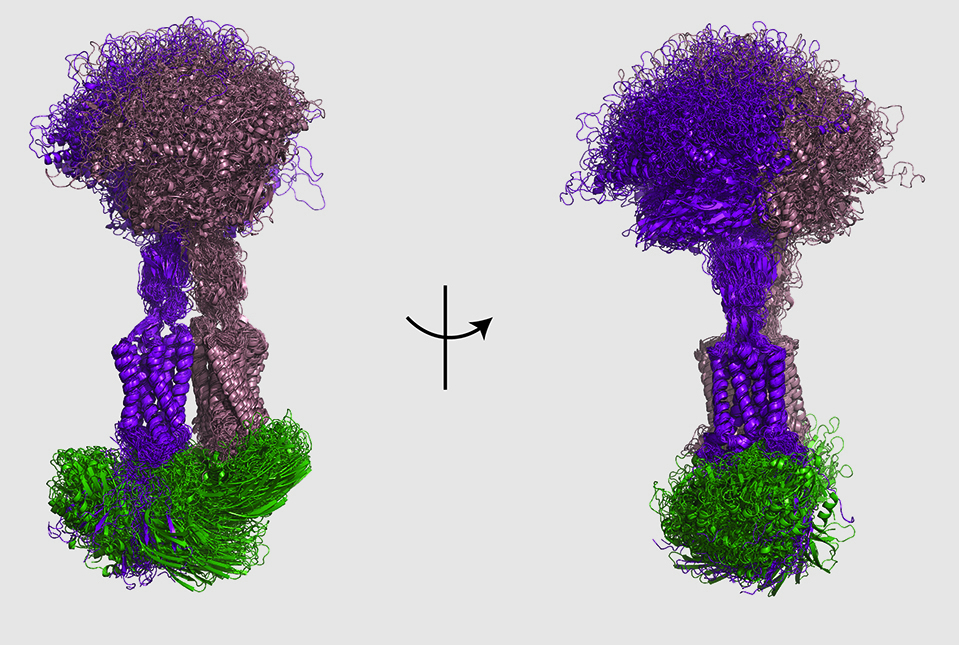
Dr. Levitz and his team used electron microscopy, molecular dynamics simulations, and a new single-molecule capture method they developed, to discover an unexpected variety of couplings between beta arrestins and mGluRs. The results clarified important details for future drug design, showing for example how different mGluR subtypes can form complexes with different numbers of beta-arrestin subtypes in a range of orientations with different types of inter-molecular interactions.
“Essentially we catalogued the molecular diversity of these complexes, because if you don’t know what complexes are possible, you can’t possibly know how to target them,” Dr. Levitz said.
The experiments focused on one mGluR subtype, mGluR8, which is known to be involved in the brain’s normal regulation of anxiety, though the researchers consider its structure also broadly representative of the mGluR family. Most critically, a three-dimensional structure of mGluR8 provided a first high-resolution snapshot of an active mGluR/beta-arrestin complex, providing a foundational model for future mechanistic and drug-development work.
In particular, researchers would like to be able to target mGluRs without triggering increases in beta-arrestin binding—increases that would desensitize the receptors to drug treatment.
“The structures we determined in these studies suggest that this approach would be possible,” Dr. Levitz said.
This work is supported by NIH grants F31NS129320, F32GM148001, R01NS129904, R35GM136686; the Margarita Salas Fellowship from the Ministry of Universities of Spain; the Charles Revson Fellowship; the Rohr Family Research Scholar Award; and the Monique Weill-Caulier Award.

