

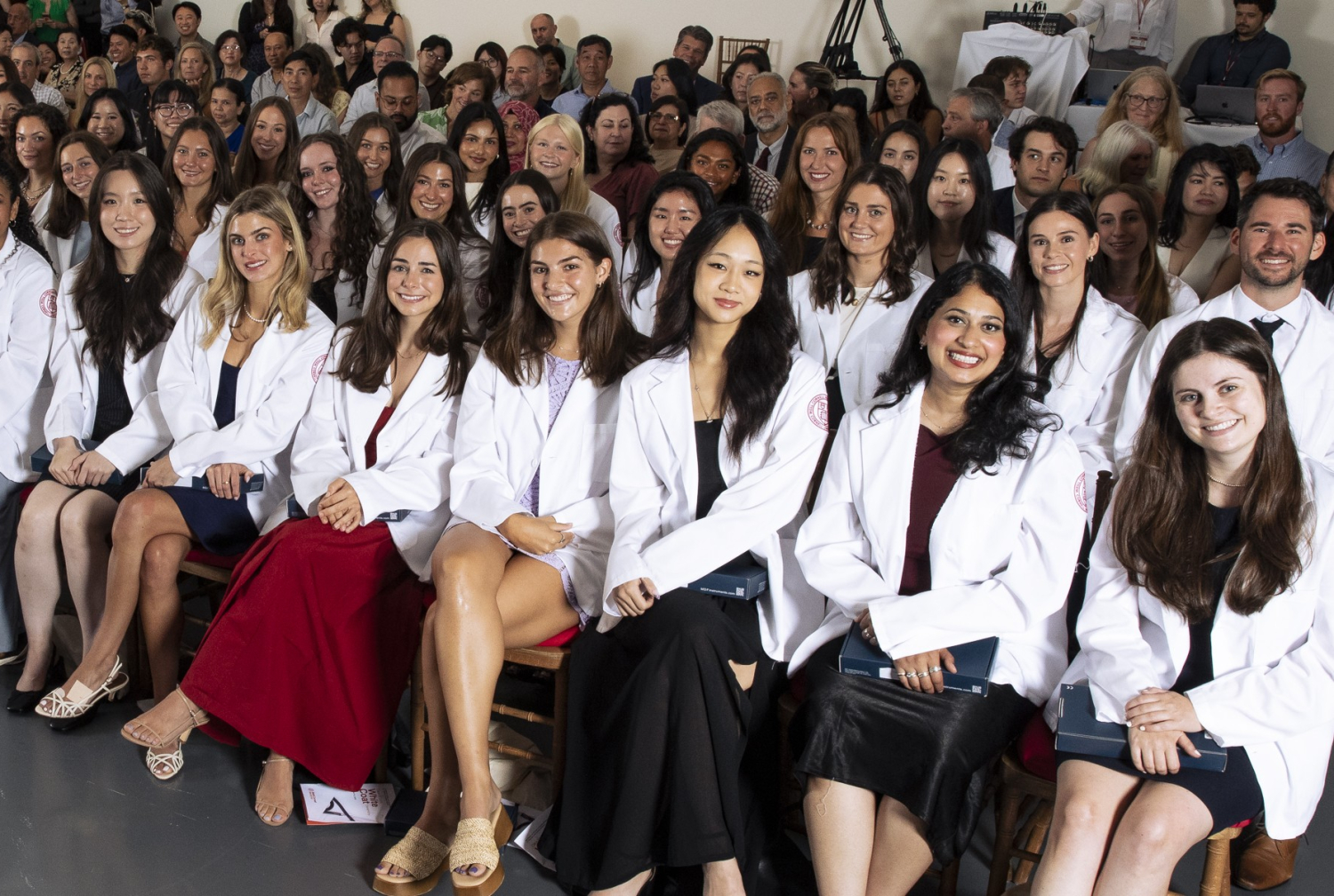
Nina Almazar can trace her passion for healthcare to her untraditional upbringing, her family’s sacrifices—and her deep love for her grandmother.
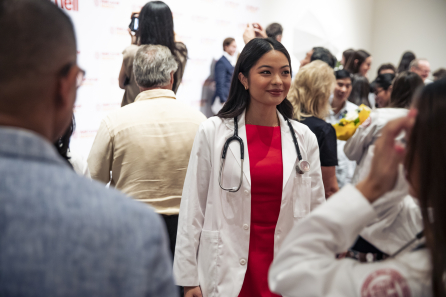
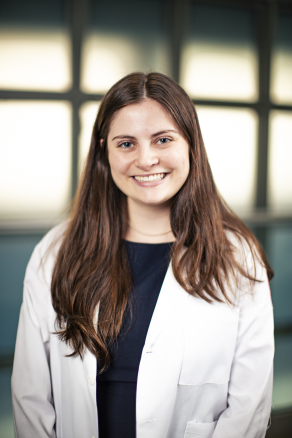
Nina Almazar Aug. 18 during the white coat ceremony. To view our full photo gallery, click the picture. All photos: Reece Taylor Williams.
Born in the Philippines, Almazar spent her early childhood living with her maternal grandmother while her parents emigrated to the United States in search of more opportunity for their family—reuniting in Queens when Almazar was 5 years old. Her mother, a dentist back home, worked odd jobs as a nanny and tutor before eventually attending nursing school, while her father’s workday extended to nights and weekends. It was challenging, but worth it: “This is why we came here,” Almazar recalled her parents saying. “To make sure you would have a good education and could do whatever you want with your life.”
She always gravitated to the sciences, but her passion grew when her grandmother, who also moved to the United States, was diagnosed with cancer when Almazar was at Villanova for college. The oncologist was lovely, Almazar said, but the physician assistant really got to know her grandmother, was honest about the severity of her illness but instilled hope. The experience even inspired Almazar to work as an intern at Memorial Sloan Kettering Cancer Center. Ultimately, she chose to pursue a career as a physician assistant to forge connections with patients—the same connection she had with the PA assisting her grandmother’s care.
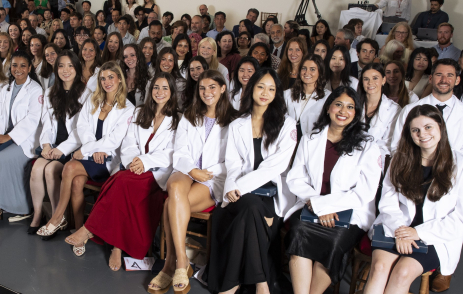
PA students in the Class of 2028.
Almazar is now one step closer to attaining her goal, joining the incoming class of the Weill Cornell Medicine Master of Science in Health Sciences for Physician Assistants Program. On Aug. 18, at the program’s White Coat Ceremony, she and 49 of her fellow students received their white coats from leadership and faculty members, signifying the start of their educational journey. The 27-month-long program offers 14 clinical rotations, allowing students to experience a range of healthcare specialties.
“It’s literally a moment that you dream about,” Almazar said. “The white coat is the physical manifestation of three beautiful letters—PA-C—that you have the privilege of earning.”
“Today marks the beginning of a remarkable journey,” said Dr. Kelly Porta, associate dean of physician assistant studies and PA program director. “Each of you arrives here with unique experiences, talents and aspirations, but you now share a common purpose: a commitment to serving patients, advancing healthcare, and embracing the values of Weill Cornell Medicine and the PA profession.”
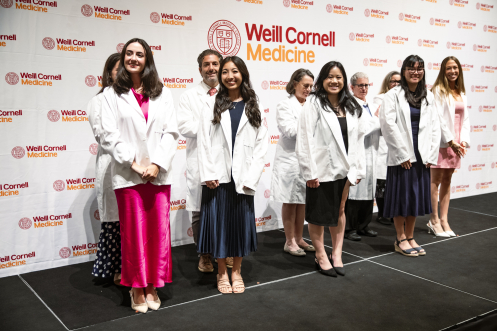
PA students receive their white coats from Weill Cornell faculty. Students, from left: Ashleigh Meskill, Eri Mizuguchi, Bianca Nguyen, Suong Nguyen and Kelly Owens.
“We want you to feel cloaked, as with the white coat, by our profession’s commitment to earn trust, understand vulnerability and offer the most personalized compassionate care,” said Dr. Robert A. Harrington, the Stephen and Suzanne Weiss Dean of Weill Cornell Medicine and provost for medical affairs of Cornell University. “Remember who you are, and what you stand for, as you put on your white coat today.”
Dr. Joseph Safdieh, the Richard P. Cohen M.D. Senior Associate Dean for Education, highlighted the profession’s history, noting that the students are joining “a tradition of excellence that stretches back generations and a profession that has transformed healthcare across our nation,” adding that this year is particularly meaningful, as Weill Cornell celebrates 50 years of educating physician assistants. “For half a century, our graduates have cared for patients, advanced science, taught learners and improved countless lives.”
Chloe Frabotta celebrates earning her white coat.
In her alumni address, Jennifer Kenney ’25, emphasized the significance of the ceremony. “Regardless of who you were the day before, the white coat transforms each of us from regular citizens to members of the healthcare team striving to do our best for those who put their trust in us,” she said. “It is also a promise. It represents years of sacrifice, a commitment to lifelong learning and an oath to place the needs of others before your own.”
For Chloe Frabotta, a love of science class in school led her to major in biology at Boston College, where she assumed lab work would interest her the most. “I did enjoy the research and lab aspect of my studies, but what I really loved was working with people—the face-to-face interactions,” she said.”
Following graduation, Frabotta was employed as a medical assistant in a dermatology office for two years, as she considered the healthcare profession. She worked for a melanoma specialist, and many of the patients who came in were high-risk or anxious about a cancer diagnosis.
“The most rewarding part was learning about them—who they were as people and not just patients—and forming connections with them and their families,” she said. For Frabotta, the prospect of becoming a physician assistant just made sense as she could combine her science background and love of helping others.
“I feel really grateful,” she said, reflecting on the start of her PA journey. “It’s been a really long process to get to this point. And to finally be getting the white coat, which symbolizes what we’ll be learning and the care we’ll be providing, is very exciting.”
View full White Coat Ceremony video here.

