

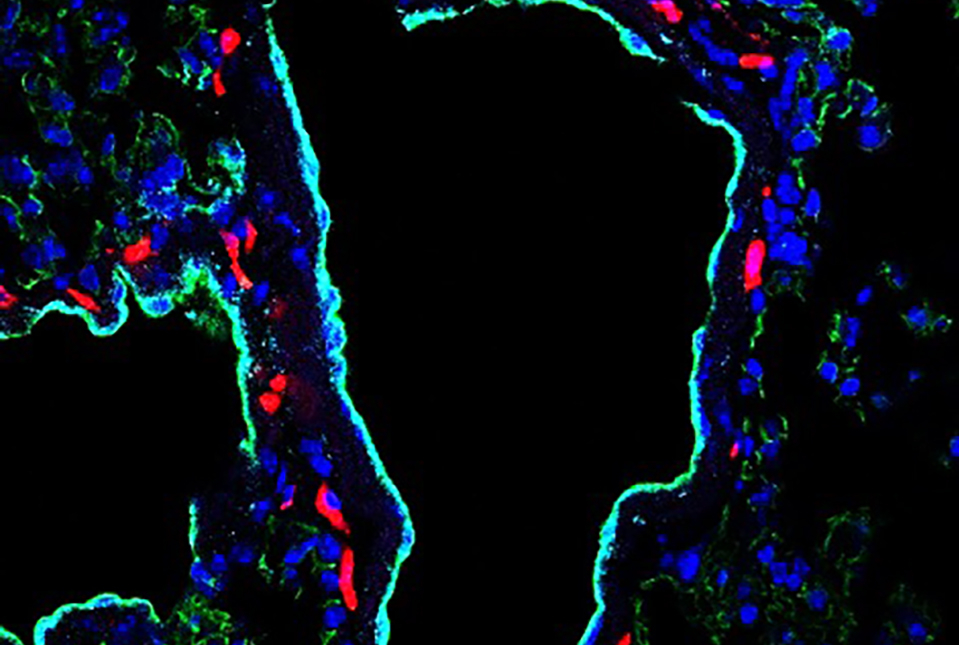
A protein secreted by common cancer types makes blood vessels leakier to allow metastatic tumors to form in the lungs, according to a study led by investigators at Weill Cornell Medicine and Memorial Sloan Kettering Cancer Center. The discovery could lead to new ways of monitoring and reducing lung metastasis risk in cancer patients.
The researchers, whose findings appear Aug. 5 in Nature Cancer, sought to explain how some tumors enhance their ability to metastasize to the lungs by secreting tiny capsules and particles that carry proteins, DNA and other molecules. These extracellular vesicles and particles (EVPs) are secreted by virtually all cells as a way of signaling to other cells and helping to shape their environments—and tumors have adapted them for their own purposes. In the study, the researchers identified a protein called integrin alpha-5 as the cargo in a tumor-derived EVPs that promotes lung blood vessel leakiness and lung metastasis in several types of cancer.

Dr. David Lyden. Credit: Ashley Jones
“These findings help us understand one of the mechanisms underlying lung metastasis, so that we can start to think about ways to detect and block it to improve outcomes for patients,” said study senior author Dr. David Lyden, the Stavros S. Niarchos Professor in Pediatric Cardiology and a member of the Gale and Ira Drukier Institute for Children's Health and the Sandra and Edward Meyer Cancer Center at Weill Cornell Medicine.
The recognition that EVPs secreted by tumor cells represent an important layer of cancer biology has come only in the past two decades. As Lyden’s and other labs have shown, tumors use the molecular cargo of EVPs to create a local “pro-tumor” environment and prepare distant organs for metastasis. Tumor EVPs and the molecules they carry are now viewed as promising targets for cancer therapies and for cancer detection and monitoring technologies called liquid biopsies that rely on analysis of blood samples.
In earlier work, Lyden lab researchers found that some tumors’ EVPs have a potent ability to facilitate lung metastasis by inducing a leakiness in blood vessels that allows circulating tumor cells to enter the lungs. In the new study, they looked for the EVP cargo responsible for this effect.
They confirmed in animal models that for some cancers—melanoma, osteosarcoma, and colorectal, in particular—tumor implantation elsewhere in the body can trigger large increases in lung blood vessel leakiness, doing so via tumor-secreted EVPs. They found that these EVPs have the same effect when injected on their own into healthy, tumor-free mice.

Dr. Shani Dror
“This effect on lung vessels is surprisingly rapid—we could measure it just an hour or two after injecting the EVPs,” said study first author Dr. Shani Dror, a research associate in the Lyden lab.
The researchers expected to find that these EVPs cause vessel leakiness by acting directly on the endothelial cells lining blood vessels. They found instead that the EVPs work indirectly via immune cells called macrophages that reside close to lung blood vessels and exert their effect only when they carry integrin alpha-5. Even a breast tumor model that is not prone to metastasize did so readily when EVPs containing integrin alpha-5 were added. The scientists showed that integrin alpha-5 works on lung macrophages by inducing them to secrete the pro-inflammatory protein IL-6, which then causes nearby endothelial cells to loosen up vessel linings.
To confirm that the results were relevant beyond animal models of cancer, the researchers analyzed a large dataset of gene expression in human tumors, finding that high expression of integrin alpha-5 in several tumor types, including colorectal tumors, is associated with poorer overall survival. They also found tumor samples from patients with intermediate to advanced colorectal cancer released EVPs containing integrin alpha-5 and were indeed capable of inducing vessel leakiness.

Dr. Jacqueline Bromberg. Courtesy of MSK
The results reveal a key metastasis-promoting mechanism in some cancers and have potential clinical implications.
“One possibility is that we could try to detect these integrin alpha-5-containing EVPs during cancer surgery, to assess the risk of metastasis,” said study co-corresponding author Dr. Jacqueline Bromberg, a breast oncologist at MSK and an associate professor of medicine at Weill Cornell Medicine. “If we had a good drug for blocking integrin alpha-5, we could give this at the time of surgery to potentially reduce the risk of metastasis.”
Many Weill Cornell Medicine physicians and scientists maintain relationships and collaborate with external organizations to foster scientific innovation and provide expert guidance. The institution makes these disclosures public to ensure transparency. For this information, please see the profiles for Dr. David Lyden.
The research reported in this story was supported in part by the National Cancer Institute, part of the National Institutes of Health, through grant number CA232093. Additional support was provided by the Hartwell Foundation, the Breast Cancer Research Foundation, the Tortolani Foundation, the Malcolm Hewitt Weiner Foundation, the Manning Foundation, the Theodore A. Rapp Foundation, the AHEPA Vth District Cancer Research Foundation, the Children’s Cancer and Blood Foundation, The Sandi Feinberg and Tara Lipton Family Foundation, and The Pershing Square Sohn Foundation.

