

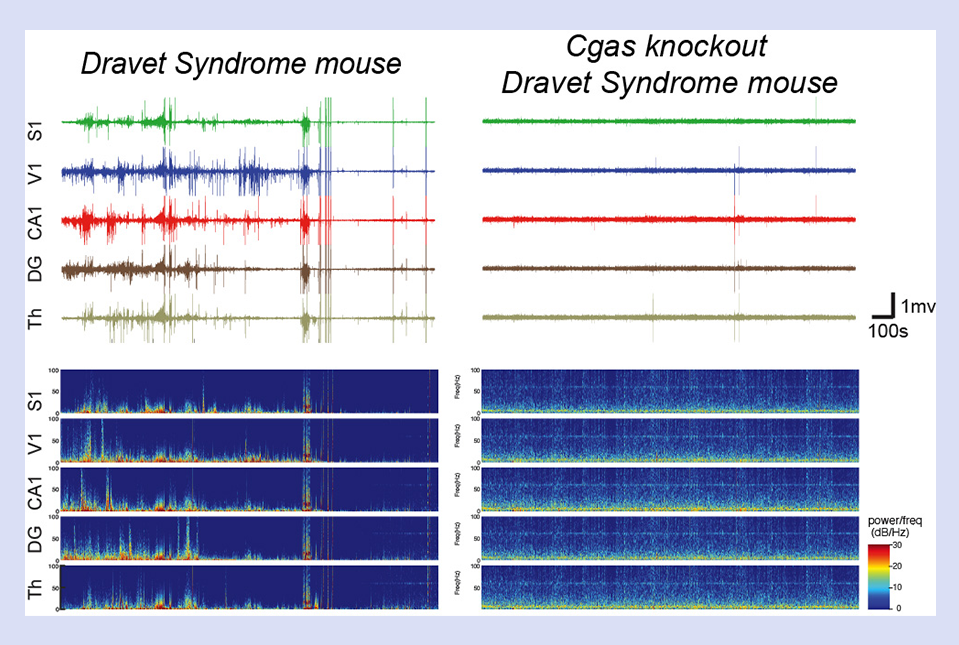
An overactive immune response in the brain may play a role in Dravet Syndrome, a rare and severe genetic epilepsy that typically begins in infancy, according to Weill Cornell Medicine researchers. Children with the condition experience frequent seizures that are often difficult to control with medication and may also face developmental, cognitive and behavioral challenges. Until now, most research has focused on how a mutation in the SCN1A gene disrupts electrical signaling in the brain.
“Rather than being a disorder only involving abnormal electrical signaling, the disease may also involve a self-sustaining immune response triggered by DNA released from stressed neurons,” said study senior author Dr. Li Gan, the Burton P. and Judith B. Resnick Distinguished Professor in Neurodegenerative Diseases and director of the Helen and Robert Appel Alzheimer’s Disease Research Institute at Weill Cornell. “As a result, inflammation may help drive and sustain the disease. This finding links seizures to the brain's immune system in a way that had not been fully appreciated before.”

Dr. Li Gan
The new preclinical study, published July 29 in Nature Neuroscience, identified an inflammatory pathway called cGAS-STING-interferon (IFN-I) signaling as a major contributor to disease progression. Blocking this molecular pathway could lead to new therapeutic strategies for epilepsy disorders. First author, Dr. Yige Huang, a graduate student in the Gan Lab at the time, helped lead the research.
This pathway is part of the body's innate immune system and normally helps cells detect foreign DNA from viruses or other threats. The team found that the system is triggered when overactive neurons—nerve cells that fire excessively during seizures—become stressed and release fragments of their DNA.
Brain immune cells known as microglia detect this DNA using a sensor called cGAS. Once activated, cGAS triggers a cascade involving STING and interferon signaling, leading to widespread inflammation in the brain.
According to the authors, this creates a harmful feedback loop. Seizures and abnormal neuronal activity damage cells, causing DNA release. The DNA activates microglia, which launch an inflammatory response, particularly in the hippocampus, a brain region implicated in seizures. That inflammation, in turn, can make the brain even more susceptible to seizures.
Uncovering a New Feedback Loop
To test how cGAS may contribute to seizures, the team genetically reduced cGAS activity in a mouse model of Dravet syndrome. Mice with reduced cGAS activity experienced less severe seizures, required stronger stimulation to trigger seizures and showed lower levels of abnormal brain activity.
They also treated the models with an experimental drug, which inhibits cGAS. The treatment reduced inflammatory changes in both microglia and astrocytes, another type of brain support cell involved in neurological disease.
The findings suggest that cGAS acts as a critical link between neuronal dysfunction and neuroinflammation. By interrupting this signaling pathway, the researchers were able to calm the brain's immune response and reduce seizure susceptibility.
The researchers also analyzed brain tissue obtained from people with drug-resistant epilepsy without the Dravet syndrome mutation. In these samples, they observed heightened gene activity in microglia associated with the body's type I interferon response and increased expression of several components of the cGAS-STING pathway, suggesting that the inflammatory response may be relevant to human disease as well.
Therapeutic Potential
The researchers noted that cGAS inhibition appeared to normalize many of the downstream biological changes caused by the SCN1A mutation. Genes involved in communication between neurons, synaptic function and brain excitability moved closer to normal patterns after cGAS inhibition. “Reducing the inflammatory consequences of the mutation might provide meaningful clinical improvement for patients with Dravet syndrome,” said Dr. Gan.
More broadly, since activation of the cGAS-STING pathway was observed in drug-resistant epilepsy beyond Dravet syndrome, the mechanism may extend to other seizure disorders. “We could identify biomarkers in the cerebrospinal fluid or in the plasma that can select patients with seizures who would be suitable for this kind of intervention,” Dr. Gan said. “Future studies will be needed to determine whether cGAS inhibitors could benefit a wider population of patients.”
Many Weill Cornell Medicine physicians and scientists maintain relationships and collaborate with external organizations to foster scientific innovation and provide expert guidance. The institution makes these disclosures public to ensure transparency. For this information, please see the profile for Dr. Li Gan.
This work was partly supported by the National Institutes of Health (grants R01AG076448, R01AG072758, R01AG079557-01, 1R01AG079291-01A1, R01AG074541, K99AG078493, R01NS145443, R01AG092683 and R61AG094667); Rainwater Charitable Foundation; Freedom Together Foundation; Cure Alzheimer’s Fund; Daedalus Fund; BrightFocus Foundation Postdoctoral Fellowship in Alzheimer’s Disease Research (A20201312F) and JumpStart Research Career Development Program.

