


On a Monday evening on the fourth floor of Helmsley Medical Tower, a Weill Cornell Medicine medical student leans in to take a patient’s history—in Spanish, English or sometimes both—before stepping out to present the case to an attending physician. Months later, that same student may be messaging that patient about lab results, helping schedule a specialist visit or urging them to go to the emergency room if needed.
At the Weill Cornell Community Clinic (WCCC), this scenario isn’t the exception—it’s the model. Over the last two decades, the student-founded clinic has become a bedrock of care for uninsured New Yorkers while also evolving into a deeply embedded part of medical education at Weill Cornell Medical College. Staffed by volunteer physicians but largely run by medical students themselves, the WCCC serves about 120 patients each year, many of whom return regularly for primary care, chronic disease management and mental health services.
As it marks its 20th anniversary, WCCC leaders say the clinic’s greatest strengths—student-driven innovation and a growing set of institutional partnerships—are cause for celebration, even as they worry about sustaining vital support.
Patient Impact
Gaining the trust of patients—many whom live near the poverty line—is as crucial to providing quality care as the diagnostic and treatment process. Hailing from all five boroughs, patients experience familiarity and continuity of care at the WCCC, traits hard to find in a fragmented health care system that’s often challenging for underserved populations.
With the seventh largest percentage of uninsured residents among large urban areas in the United States, New York City is home to an estimated 700,000 residents between 18 and 64 who lack health coverage, according to the New York City Department of Health and Mental Hygiene.
“We really do try to be their consistent physicians,” said Santiago Noriega Madrazo, who serves as WCCC co-executive director with Diego Rodriguez, both M.D.-Ph.D. students in the Tri-Institutional M.D.-Ph.D. Program.
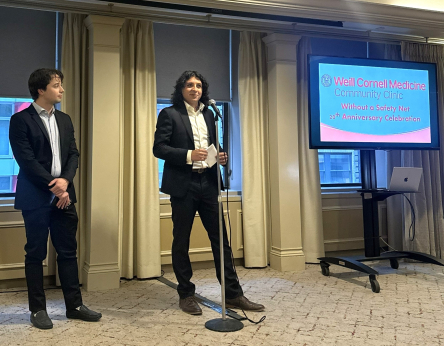
WCCC Co-Executive Directors Santiago Noriega Madrazo (left) and Diego Rodriguez, at the clinic's annual fundraiser in April.
“What our patients appreciate is the comfort of knowing they have people they can depend on, whom they trust with their health,” said Dr. Cecilia Nicol, an assistant professor of clinical medicine at Weill Cornell Medicine and medical director of the WCCC, who took the helm two years ago and whose clinic involvement extends back to her own medical school training at Weill Cornell, where she earned her medical degree in 2018. “We’re really a gem of a medical clinic in helping patients navigate the health system.”
This continuity builds trust and leads to better outcomes, said WCCC Medical Director Emeritus Dr. Pamela Charney. A prime example was during the COVID-19 pandemic, when students quickly pivoted to offer telehealth visits and later sent all patients care boxes containing masks, gloves and COVID educational pamphlets. “When the time came to roll out the COVID vaccines, our patients all accepted it—because the trust was there,” said Dr. Charney, a professor of clinical medicine at Weill Cornell who served as WCCC medical director for more than 10 years and still volunteers weekly, assisting Dr. Nicol. “That says a lot about the care we provide.”
Education Through Responsibility
Nearly every medical student rotates through the clinic over their four years at Weill Cornell, while dozens volunteer on a regular basis and a team of more than 50—divided into two boards—leads the larger effort.
With patients, students are the primary point of contact—not relegated to a back-up player. “Students do everything from scheduling appointments to checking people in, to taking the patient history, performing an exam and presenting the case to an attending,” Dr. Nicol said. “Then I do an exam and talk to the patient. Students also do the follow-up calls and interpret the labs with attending supervision.”
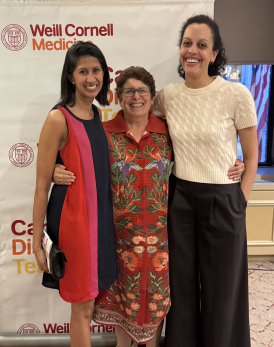
From left: Dr. Ashita Batavia, one of the clinic's founders, Dr. Pam Charney, WCCC medical director emeritus and Dr Cecilia Nicol, current medical director of the WCCC.
Twice a month, the WCCC also offers gynecology and mental health clinics, with students providing cognitive behavioral therapy under the guidance of doctoral-level psychologists. This degree of independence has proven invaluable to students as they become full-fledged doctors, clinic leaders say. And so has the exposure to underserved New Yorkers, which can shape how students think about equitable care.
“Many new students say that one of the reasons they decided to come here is because they like the work the WCCC is doing,” Noriega Madrazo said. “I’m happy we attract students who are excited about community work. It’s a huge asset for Weill Cornell that we recruit those types of students.”
“The deep dedication and commitment of our medical students to the WCCC reflects how much they value the promotion of health and management of illness for traditionally underserved communities in New York City,” added Dr. Joseph Safdieh, the Richard P. Cohen M.D. Senior Associate Dean for Education at Weill Cornell. “We are proud to support this initiative, which is celebrating such an important milestone.”
Growing Partnerships
Among the clinic’s major accomplishments over the past several years is a surge of institutional partnerships. WCCC now facilitates free specialty and surgical care across 21 departments at Weill Cornell Medicine and NewYork-Presbyterian/Weill Cornell Medical Center, including in cardiology, radiology, pathology and gastroenterology.
Other significant developments include the recent launch of a new dermatology clinic and an emerging diabetes program to provide insulin and glucose monitoring equipment to patients. “The growth has been amazing,” Dr. Charney said.
Since most WCCC patients have a chronic condition such as high blood pressure, high cholesterol or diabetes, these partnerships “are really what allow us to treat patients with more complex needs and help us make sure patients get the timely care they require,” Rodriguez said. “We’ve been able to expand both the level of care and the types of patients we can serve.”
Looking Ahead
Sustaining this momentum is top of mind for WCCC leaders, who hope to continue expanding collaborations and services over the coming years, but they also know that such support can be challenging to maintain. “One of our biggest priorities is cementing these partnerships within the clinical DNA of Weill Cornell Medicine so we’re never behind,” Rodriguez said. The center’s annual fundraiser, held April 23 at the Cornell Club, celebrated the 20th anniversary, with WCCC leaders, students and supporters in attendance.
Ultimately, Dr. Nicol said, the WCCC’s success comes down to the students. “They’re so passionate and engaged,” she said. “They love this work as much as I do, and it’s really inspiring to see this next generation of medical students who care so much.”

