

When Dr. Louisa Schilling was 15 years old, she read a book called “The Brain that Changes Itself,” by Norman Doidge. Her father, who has a doctorate in microbiology and immunology, received it at a conference and it ended up in his daughter’s hands. Her immediate reaction: “I want to study the brain.”
“The book was all about neuroplasticity, and I was really taken by the idea that what we spend our time doing changes our brain, “she said. “And I just felt empowered by that idea—that what I chose to spend my time doing would change me fundamentally.”
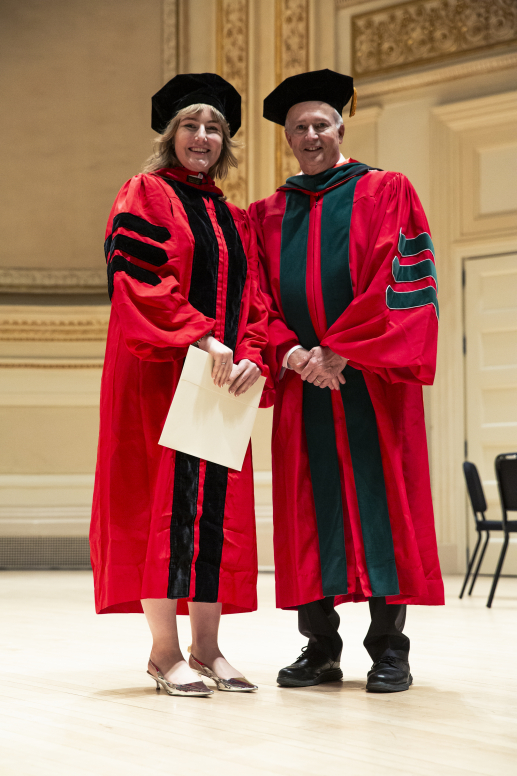
Dr. Louisa Schilling, left, poses with Dean Robert A. Harrington May 14 after crossing the Perelman stage at Carnegie Hall during Commencement. Credit: Reece Taylor Williams
After completing her undergraduate degree in neuroscience and cognitive science at the University of Toronto and earning a master’s degree from the Humboldt-Universität zu Berlin (Berlin School of Mind and Brain), she joined the neuroscience doctoral program at Weill Cornell Graduate School of Medical Sciences in 2021.
Throughout the years, Dr. Schilling often found herself drawn to the neuroscientific study of addiction, a subject she finds to be extremely timely in America right now. Her doctoral research focused on children with a family history of substance use disorder—seeking to identify sex-specific biomarkers of risk in the brain before any substance exposure occurs.
“Neuroscience is just this perfect intersection of science and humanity,” she said. “A lot of my interests are about human nature and how we interact with the world we live in. Studying the brain gives us a unique way to understand that.”
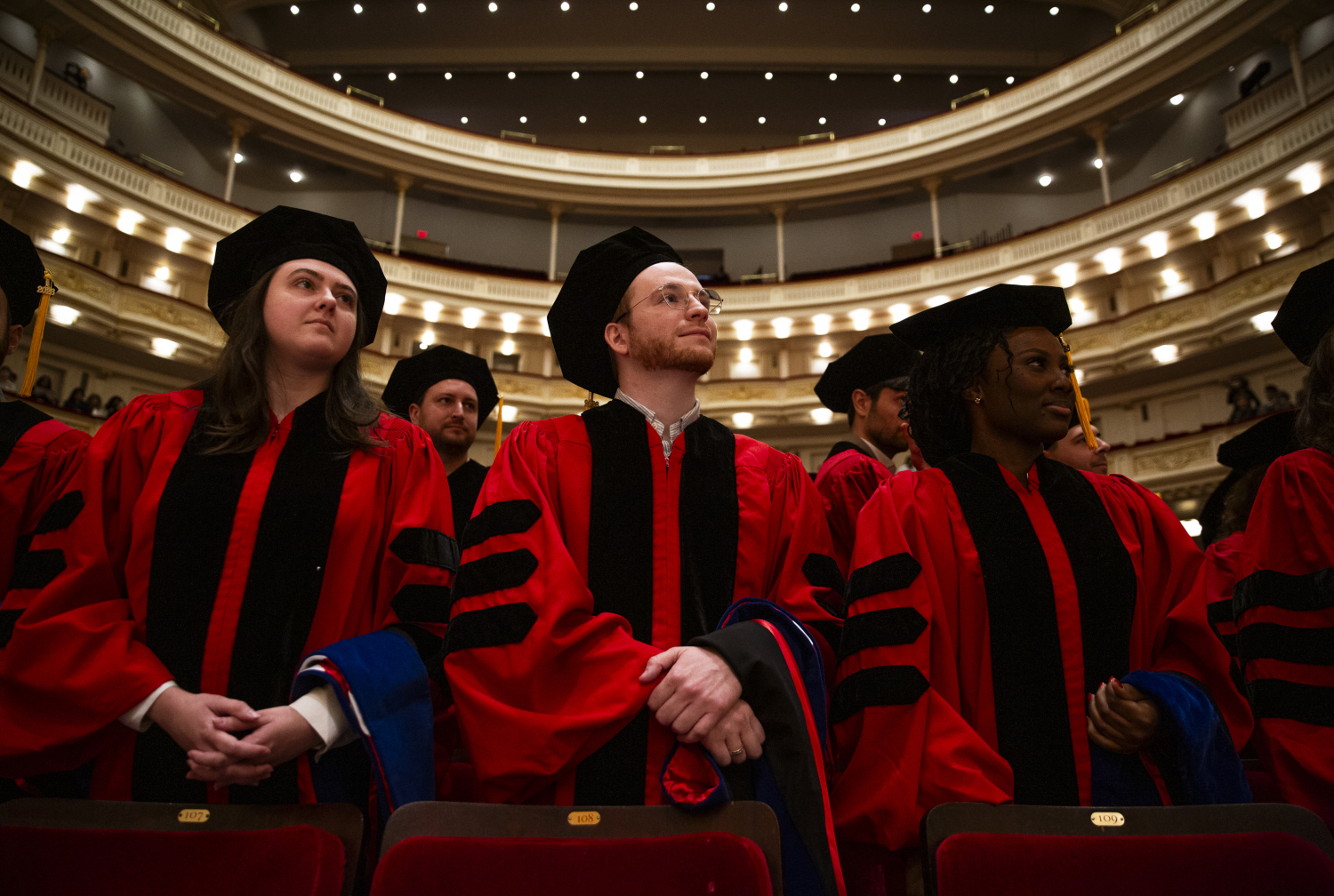
Dr. Schilling was among 311 expected Class of 2026 graduates of Weill Cornell Graduate School of Medical Sciences who celebrated their commencement May 14 at Carnegie Hall. Cornell President Michael I. Kotlikoff joined Deans Robert A. Harrington and Barbara Hempstead in conferring degrees on the graduating students—86 doctoral candidates and 225 with Master of Science degrees—who walked the stage to receive their diplomas as an audience of classmates, family and friends cheered.
For the first time in the institution’s history – and in reflection of a dramatic expansion in master's degree programs – the Weill Cornell Graduate School held a ceremony separate from Weill Cornell Medical College, whose graduates were honored that morning.
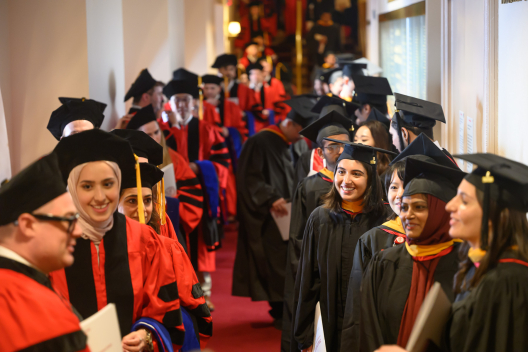
Doctorate students line the left side of a Carnegie Hall hallway, while Master of Science students line the right ahead of their Commencement May 14. Credit: Amelia Panico
Dr. Harrington, the Stephen and Suzanne Weiss Dean of Weill Cornell Medicine and provost for medical affairs of Cornell University, reminded the graduates of one of the fundamental purposes behind their work.
“Remember you are part of one of the most important pursuits that humans can undertake—the search for truth,” he said. “I loved taking journeys into the unknown, especially with a diverse team on a shared mission. Team building is one of the most important skills you’ve learned. Your shared stories will be integral to your team’s success.”
He added: “Scientific advancement is a joint effort, focused on uncovering truth that we all can get behind.”
With their graduate education complete, members of the Class of 2026 will now launch the next stage of their careers in science and medicine—postdoctoral positions at institutions nationwide, and other roles in research, academia, tech and the biomedical industry.
In his address, President Kotlikoff highlighted Cornell’s culture of collaboration, and the value of a range of perspectives in science and research.
“Collaboration takes humility and civility. It takes recognizing when you don’t have all the answers, or you’re not the right one to solve a problem,” he said. “It means respecting everyone on the team—for their contributions, and as individuals. It’s asking for a second opinion, bringing in more expertise, inviting other opinions and perspectives. It’s putting your pride where your professionalism is: caring more about getting it right, than getting all the credit.”
Dr. Hempstead, dean of Weill Cornell Graduate School of Medical Sciences, emphasized the importance of foundational science as the cornerstone of medical innovation.
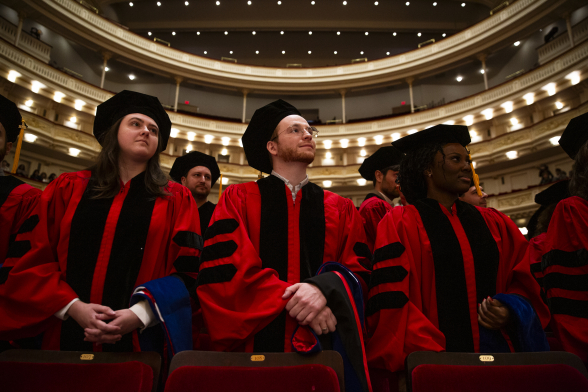
Doctoral students graduate from Weill Cornell Graduate School of Medical Sciences May 14 during Commencement at Carnegie Hall. Credit: Reece Taylor Williams
“The foundational biological sciences are the critical building blocks upon which all medicine rests,” she said. “Without foundational science, there are no new drugs, new treatments, new algorithms to detect, prevent and effectively treat disease.”
“Simply put, there is no medicine without science,” Dr. Hempstead said. “Yet, many people won’t understand how important and impactful your work is. The timelines are lengthy, and the discoveries made today might not bear fruit until years down the line.”
Student speaker Dr. Kenneth Wayne Johnson, a graduate of the pharmacology program who will continue at Weill Cornell as a postdoctoral researcher, issued a call to action to the Class of 2026.
“As we leave here today, we carry more than degrees. We carry the responsibility to use what we have learned to improve the lives of others,” he said.
“The world does not need perfect scientists. It needs people who are willing to keep going when things are uncertain, to keep asking questions when answers are hard and to keep working together toward something better,” Dr. Johnson said. “If we do that, what comes next will be better than what came before.”

