

Even as the national conversation around diversity, equity and inclusion is muted, Weill Cornell Medicine continues its work to make sure everyone has a seat at the table.
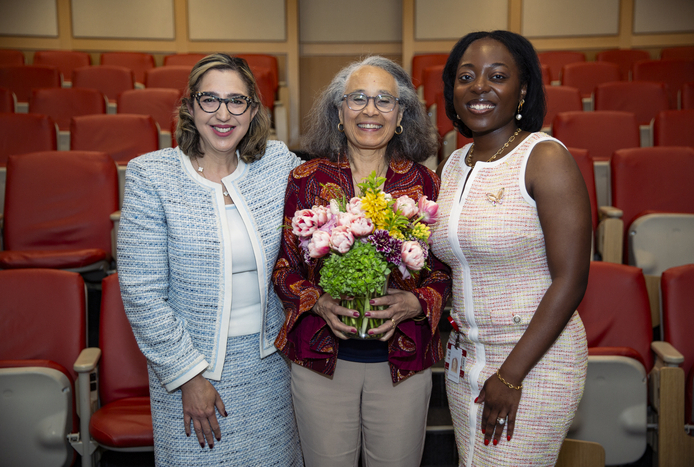
That was the message relayed on April 23 by Dr. Linnie Golightly, provost and senior associate dean of academic affairs at CUNY School of Medicine. Dr. Golightly was joined by Dr. Heidi Bender, inaugural associate dean for faculty engagement and inclusion, and Fanesse Acquaye, executive director of the Office of Culture, Inclusion & Employee Experience for a fireside chat, as part of the institution’s eighth annual Diversity Week.
The nearly hour-long conversation explored Dr. Golightly’s legacy at Weill Cornell Medicine and her lifelong commitment to building institutions where everyone can feel they belong and every voice is heard. A 1983 graduate of Weill Cornell Medicine, Dr. Golightly spent close to 30 years of her professional career at the institution—joining the faculty in 1997 and then serving as associate dean of diversity and inclusion from 2016 until her departure in 2025.
She also discussed how she’s continuing the work in her current role, noting that the process continues by focusing on the opportunities ahead instead of looking back at the challenges already overcome. She stressed the importance of bridge-building—engaging skeptics and those unfamiliar with this work rather than retreating into like-minded circles.
“How do we get on that other person's wavelength? Sometimes you'll feel there's just no way, and sometimes the wavelength is toxic. And you say, ‘We have to just try another time.’ We have to keep trying, never giving up what we really believe towards justice,” she said.
“How do you talk across differences? I may not agree with you ever, but I can speak to you respectfully and understand you,” Dr. Golightly added.
For Dr. Golightly, community is central to that work. In the beginning, she said, the work was driven by individuals and groups who simply cared about creating a more inclusive environment.
“It wasn't formal. We weren't appointed. [We thought] ‘How do we look across the landscape and plan and think about what we can do for the institution?’ Because we cared about these issues of justice and belonging,” she said.
Over time, what started as colleagues looking out for each other—as well as their medical students and patients—through informal discussions became structured programs, offices and the institution-wide focus that is currently supported by Weill Cornell. Progress can be measured by making sure everyone “has a voice in the room,” said Dr. Golightly.
She encouraged attendees in the room and watching online to continue breaking down traditional hierarchies and to bring others along in that effort, adding that insights and leadership can come from anyone, and that thinking beyond typical DEI is one way that the institution can continue to grow together.
This was something she and others focused on from the beginning. She stressed that every voice in a room matters, and a medical student may have more to say than a professor. She added that even those that don’t feel like they belong should push ahead.
“If you don't think you belong at the table, maybe you don't even need the table. Maybe you don't even like the table. You can always make another table. You can always build another room,” Dr. Golightly said. “Never cede your power. Never forget you're somebody.”
The conversation also addressed the fact that, for many people, DEI has become more intimidating, as Dr. Bender explained, and some might be resistant to getting involved. This, she said, was why there is a shift from thinking about DEI from an individual level to an institutional one.
“We're all navigating difficult times and difficult climates between legal compliance and balancing that with really advancing meaningful equity and social justice initiatives,” she said. “We hear it at the diversity council meetings. We hear it in the hallways; we hear it in emails that people worry that DEI efforts may result in unintended negative consequences.”
Grounded in decades of experience, Dr. Golightly encouraged Weill Cornell colleagues and students to hold firm to their values, lean into the moment and press forward with purpose.
“I don’t think it’s a time to shy away,” she said. “We’ve been given the privilege of education and leadership. This is what you’re here for.”

