


Advancing health equity in medicine requires a clear-eyed understanding of history, a rejection of race-based clinical assumptions and a commitment to transform research into practice, said Dr. Joseph L. Wright, senior vice president and chief health equity officer of the American Academy of Pediatrics (AAP), in his keynote address for Weill Cornell Medicine’s eighth annual Diversity Week.
Dr. Wright delivered the Elizabeth A. Wilson-Anstey, EdD Lecture, “Advancing Health Equity: Why History Matters,” April 20 in Uris Auditorium as part of the institution’s commitment to greater equity, diversity and inclusion in academic medicine and health care.
Using a “roots and leaves” approach, he threaded his own family history—from enslavement to modern-day encounters with discrimination—throughout his address to emphasize how social and historical forces, especially racism, can shape health outcomes across generations. Health disparities cannot be understood without also acknowledging structural factors such as redlining, he said.
“We do know that folks don’t wake up in the fourth and fifth decade of life with chronic diseases and that the antecedent seeds that produce health disparities are sown in childhood,” said Dr. Wright, who became the AAP’s first chief health equity officer and senior vice president for equity initiatives in 2023. “The biologic effects of historically mediated trauma may linger in individuals who have seemingly escaped the more toxic environments to which their ancestors were exposed.”
Dr. Robert A. Harrington, the Stephen and Suzanne Weiss Dean of Weill Cornell Medicine and provost for medical affairs of Cornell University, said Dr. Wright’s personal and professional background epitomized this year’s Diversity Week theme, “Different Journeys, Shared Mission.” His lessons can sharpen how clinicians think about equity—not just as a goal, but as a practical lens used in everyday decision-making, Dr. Harrington said.
“It’s critical to apply an equity lens to what we do and to what we say as clinicians—including the tools we use and the standards that have been guiding us,” he added.
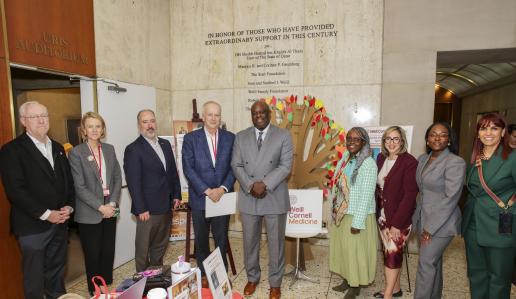
Dr. Michael I. Kotlikoff, Dr. Geraldine McGinty, Eric Saidel, Dr. Robert A. Harrington, Dr. Joseph L. Wright, Dr. Elizabeth Wilson-Anstey, Dr. Heidi Bender, Fanesse Acquaye, and Dr. Yazmin Carrasco.
Although race is a social construct, it has been inappropriately used as a biological factor in clinical algorithms—a practice known as race-based medicine, Dr. Wright said. For example, pediatric guidelines to diagnose and treat urinary tract infections had long used race to determine care decisions, an approach only recently shown to be flawed and then was retired.
“We cannot substitute race alone as a proxy for underlying biologic mechanisms,” said Dr. Wright, who previously served as the inaugural chief health equity officer of the University of Maryland Medical System as well as professor and chair of pediatrics at Howard University College of Medicine.
He challenged audience members to instead espouse race-conscious medicine, which shifts the focus from race itself to social drivers of health such as racism. Clinical guidelines must include context—such as environment and access to care—rather than superficial racial categories, Dr. Wright said.
He called on institutions like Weill Cornell Medicine to ultimately translate equity into measurable improvements in care for all patients. He also outlined a “three-horizon” model to transform research into real-world impact by generating evidence and converting it into policy initiatives that foster change—taxing efforts, he acknowledged, that entail a bevy of important traits.
“This work requires commitment, courage, humility, introspection and resolve,” Dr. Wright said.

