

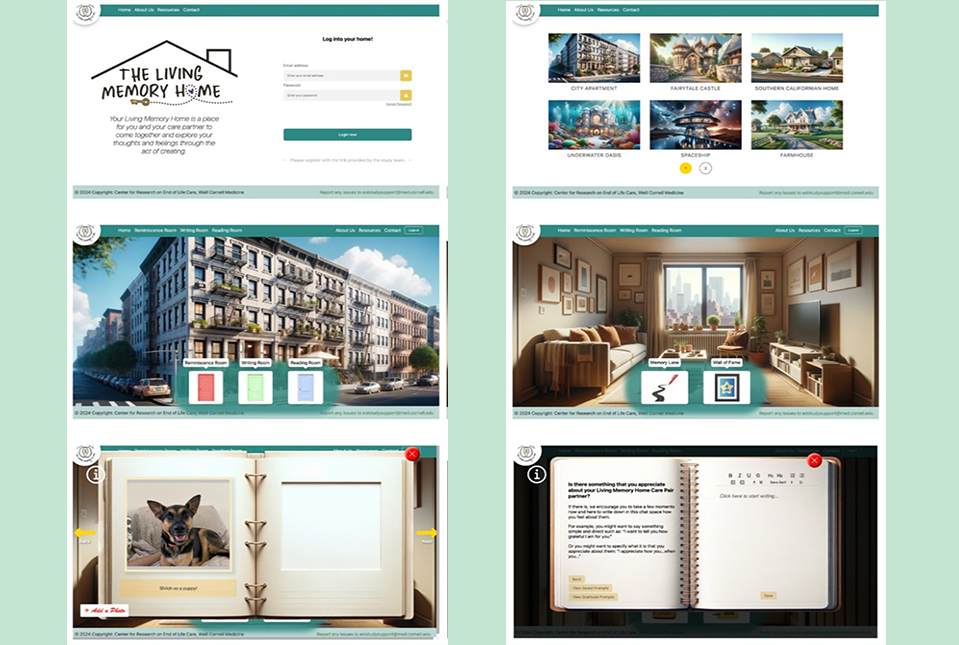
Caring for a family member with dementia can feel like losing a loved one who is still alive, but a new study suggests that revisiting memories together through a simple digital tool can help ease that grief and even strengthen the patient-caregiver bond. Weill Cornell Medicine and University of Southern California investigators have developed and tested the web-based platform, Living Memory Home for Dementia Care Pairs (LMH-4-DCP), in a pilot trial published April 22 in JAMA Network Open.
The researchers demonstrated that the digital platform can be a widely accessible, user-friendly support tool for caregivers, while enhancing appreciation of and respect for care recipients.
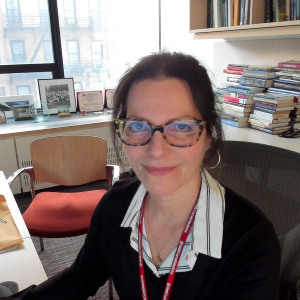
Dr. Holly Prigerson
“The caregiver is no longer interacting with the same person—they have become someone else, often an almost unrecognizable other person,” said Dr. Holly Prigerson, Endowed Professor of Diagnostics in Radiology and co-director of the Center for Research on End-of-Life Care at Weill Cornell, who co-led the study. “Not only do caregivers miss that former person, but roles between them may become reversed, and caregivers may feel trapped.”
This research was co-led with Dr. Francesca Falzarano, assistant professor of gerontology at the Leonard Davis School of Gerontology, University of Southern California.
Unlike AI memory‑book tools that passively assemble uploaded content, LMH‑4‑DCP is a clinical intervention designed to benefit both the person with dementia and their home-based caregiver. This evidence‑based activity is meant to be fun and uplifting. It integrates structured reminiscence, promotes dignity through guided reflection and uses novel metrics to evaluate outcomes.
We recently sat down with Dr. Prigerson to learn more about the platform and its potential to help the nearly 12 million Americans caring for family members or loved ones with dementia.
Why did you develop LMH-4-DCP?
Very few resources support dementia caregivers, and none of the interventions target relationships between caregivers and persons with dementia or pre-death grief—the emotional pain, sorrow and sadness which accompanies a loved one’s cognitive decline.
We adapted reminiscence therapy, which has been practiced as a scrapbooking activity focused on the person with dementia in nursing homes, using an online format. We geared it toward caregivers in their homes and made it more probing, interactive and generative.
Our goal is to help caregivers and their loved ones with dementia preserve cherished memories and maintain connections. This can help reduce feelings of loss, shame and resentment, ultimately improving quality of life for both members of what we refer to as a “care pair.”
What is LMH-4-DCP like?
LMH-4-DCP builds on our earlier online bereavement resource, Living Memory Home (LMH), for those mourning the loss of a loved one. We modified LMH to help caregivers co-create an online environment with the patient. It focuses on elements that foster pride and appreciation while generating a “living” legacy of the person with dementia and their family members.
Users log on to a privacy-protected website and choose a virtual home, which can be a spaceship, a treehouse, a castle—whatever they choose. Within this home, we have three doors. One opens to “memory lane,” where persons with dementia describe what happened in photos from their lives that appear there. Another door opens to a room with a “wall of fame,” which contains highlights of the patient’s life, focusing on their accomplishments and other sources of pride. Lastly, there’s a door opening to a “writing room” where the caregiver can interview and report on the person with dementia—a space to share their likes and dislikes and express their thoughts and feelings more generally.
To assess LMH-4-DCP, your study recruited 34 caregiver-patient pairs, with half in the therapy group and half in the control group. Participants logged in twice a week for two weeks. What were the results?
One indicator of feasibility is whether people want to use what you've built, and this was clearly the case. We recruited 68 of the 70 targeted participants easily within 6 months. Twenty-seven pairs from both groups completed follow-up assessments. Most intervention participants agreed or strongly agreed that LMH-4-DCP was easy to use (74.1%) and had well-integrated features (77.8%).
The control group accessed a restricted version of the program without reminiscence therapy features. They were asked questions about the present, like, how are you feeling today, or what do you want to eat for dinner.
We also assessed the caregivers’ experiences of pre-death grief and their relationships with their care recipients. These relationships often suffer from unresolved feelings of shame and resentment.
We were surprised at how helpful LMH-4-DCP was in two weeks, with roughly two logins per week. We significantly reduced grief severity with a trend towards improving the quality of the relationship compared with the control group.
Why is it important to address pre-death grief?
People may not be aware of how severely distressing and disabling grief is. Pre-death grief has proven remarkably like post-death grief, which characterizes Prolonged Grief Disorder. Unlike natural grief that diminishes over time, Prolonged Grief Disorder involves profound distress, hopelessness and impaired daily functioning, often benefiting from professional treatment.
We have found grief to be the strongest predictor of suicidal thoughts and behaviors; it is also linked to serious medical outcomes such as heart attacks and cancer. Detecting and addressing grief will help reduce these related risks.
What are the next steps for a follow-up study?
We are planning a larger, longer (eight-week) randomized clinical trial and will add features aimed at further reducing grief and strengthening caregiver-patient relationships. We will also build tools to assess grief in people with dementia themselves—an area that has been largely overlooked.
What did users say about the platform?
The caregivers really enjoyed it! One participant shared, “Many of the questions awakened responses and memories that I had never heard. Many were important pieces of her puzzle that we did not realize we missed out on knowing before this.” Others commented that they would continue using the program after the study: “Yes—it opened a different memory building connection and bonded us closer.”
Many Weill Cornell Medicine physicians and scientists maintain relationships and collaborate with external organizations to foster scientific innovation and provide expert guidance. The institution makes these disclosures public to ensure transparency. For this information, please see the profile for Dr. Holly Prigerson.
This work was supported by the National Institute on Aging through grants R21AG077144, P30AG072958 and ROOAG073509; the National Cancer Institute through grant R35CA197730; and the National Center for Advancing Translational Sciences through grant UL1TR002384.

