

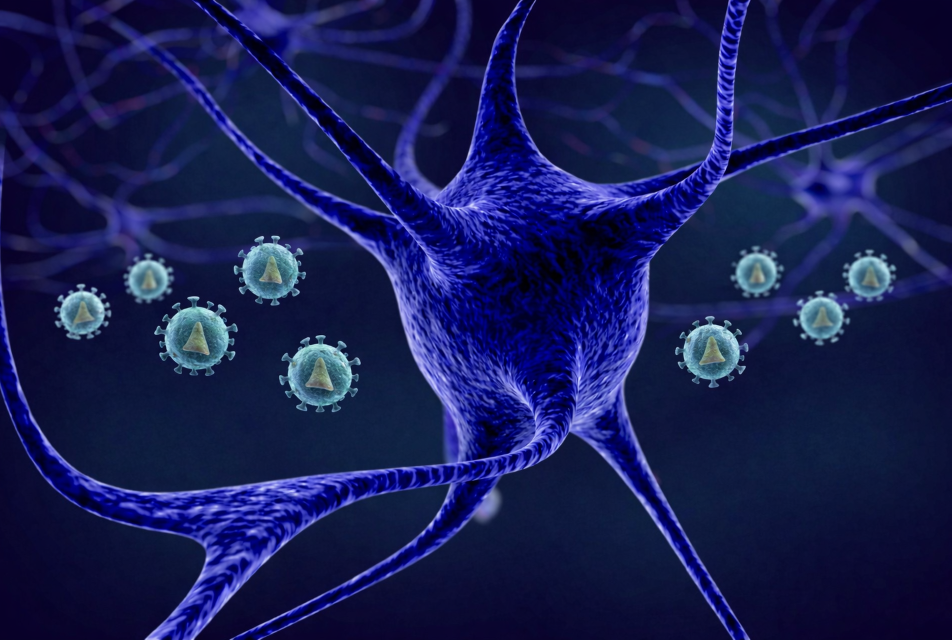
Using participant skin cells reprogrammed into neurons, Weill Cornell Medicine researchers have identified genetic signatures associated with HIV infection that may contribute to the cognitive impairment that often occurs in people living with the disease, even when the virus is controlled.
The study, published Dec. 1 in JCI Insight, collected cells called fibroblasts obtained with informed consent from the skin of six virologically suppressed people living with HIV and seven age- and sex-matched people without HIV. Applying cell-identity reprogramming techniques, they induced the fibroblasts to become neurons and found that those from the people with HIV had key differences in gene activity patterns, compared with those from people without HIV.
Some of these gene-activity differences resembled those seen in prior studies of post-mortem brain samples from people with and without HIV. Other gene-activity differences were observed for the first time, offering potential new leads to the causes of HIV-related cognitive deficits.

Dr. Teresa Evering
“These findings give us a foundation for future studies of how certain genes and biological pathways may contribute to this form of cognitive impairment,” said study senior author Dr. Teresa H. Evering, an assistant professor of medicine in the Division of Infectious Diseases at Weill Cornell Medicine and an infectious disease physician at NewYork-Presbyterian/Weill Cornell Medical Center.
After establishing an infection, HIV can enter a person’s central nervous system and infect certain brain cells, including immune cells called microglia and support cells called astrocytes. Even when antiretroviral therapy suppresses the virus to undetectable levels in the blood, HIV can persist in the brain. The effects of this chronic infection and associated inflammation can include memory problems, difficulty concentrating, mood abnormalities and slowed movements.
Despite effective HIV treatment, neurocognitive disorders affect 25–50% of people living with HIV worldwide, with prevalence and severity varying by population and study setting. Rates are generally declining in well-treated, virologically suppressed cohorts.
However, there are no treatments for the neurocognitive effects of infection partly because the underlying mechanisms of how HIV impacts neurons have been challenging to study in mouse models and post-mortem tissues. Dr. Evering’s unique model offers new way forward.
The researchers induced the sampled fibroblasts to express genes that transformed them into neurons. Unlike some other methods, this reprogramming technique produces neurons that retain age-related characteristics of the donors, an important feature for studying conditions linked to aging.
The marked gene-activity differences between the induced neurons of the HIV and no-HIV groups suggests that infection, despite virological suppression, has significant systemic effects on cells. Notably, because the neurons were derived from skin cells, the gene expression differences cannot be attributed to direct exposure to infected cells in the brain and likely reflect broader effects of HIV infection.
Among the genes with altered gene expression, the inflammatory gene IFI27 was upregulated or more active in people with HIV. Three other genes, FOXL2NB, FOXL2, and LINC01391, showed lowered expression levels linked to cognitive impairment. The researchers plan to follow up with more in-depth studies of these genes’ effects in people living with HIV and in more complex model systems.
This research was funded by the National Institute on Aging (grants R21AG071433 and R56AG078970), National Institute of Neurological Disorders and Stroke (grants R21NS126094 and R01NS117458), National Institute of Allergy and Infectious Diseases (grants UM1AI164559 and R56AI125128), National Institute of Mental Health (grant R01MH130197), National Institute on Drug Abuse (grants U01DA058527 and R01DA052027), German Research Foundation (grant HU 1636/13-1) and Koeln Fortune grant 85/2025 from Faculty of Medicine of University of Cologne.

