

Therapeutic development and careers in medicine rarely follow a straight line. They often take shape through unexpected opportunities.
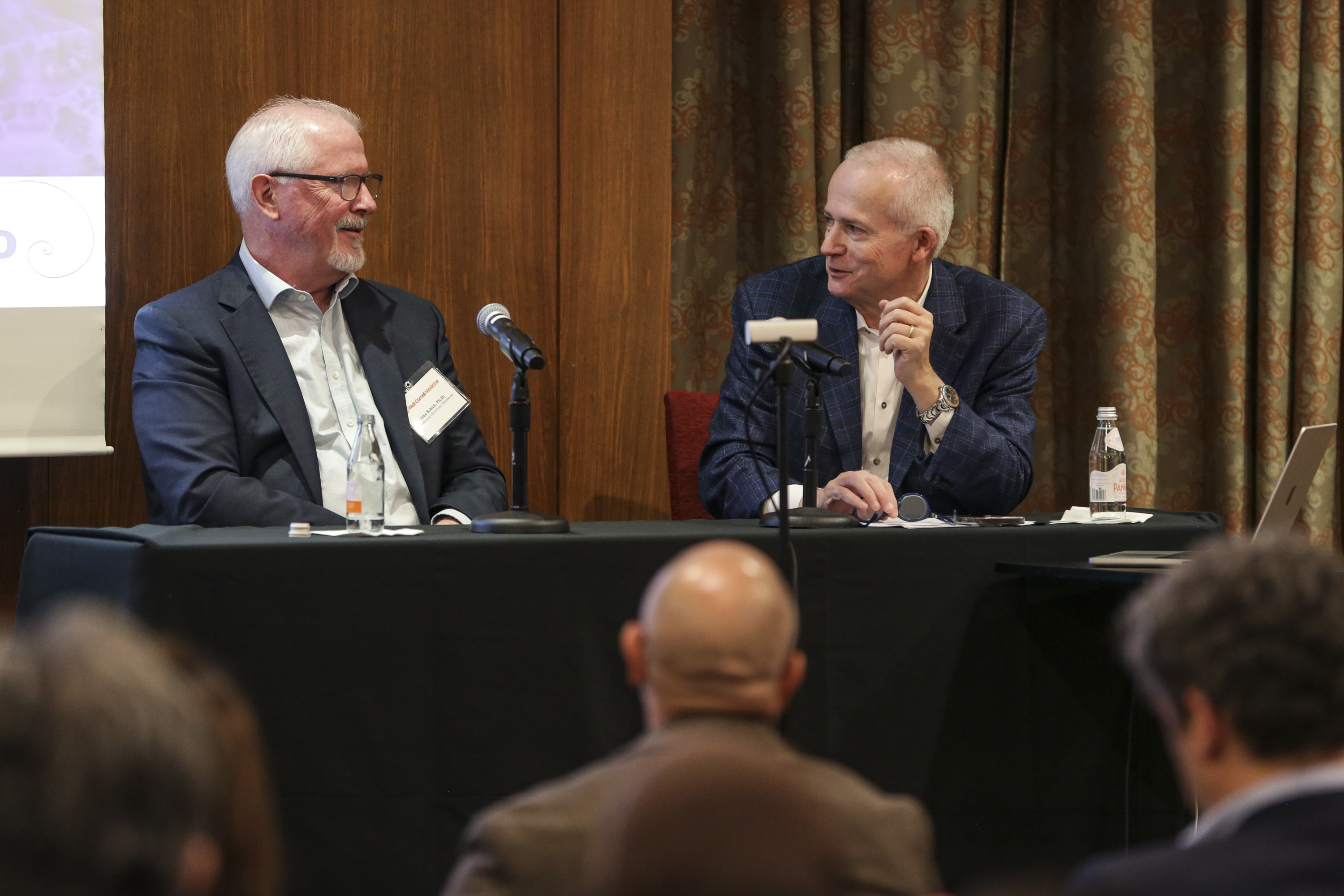
This theme characterized a fireside chat between Dr. Robert A. Harrington, the Stephen and Suzanne Weiss Dean of Weill Cornell Medicine and Provost for Medical Affairs of Cornell University, and Dr. John Babich, president and chief scientific officer of Ratio Therapeutics, at Weill Cornell’s 10th annual Dean’s Symposium on Innovation and Entrepreneurship. The event, held Nov. 11, convened researchers, clinicians, students and entrepreneurs to explore how academic discoveries can reach patients through commercial, collaborative and entrepreneurial support.
“The path toward tangible impact for research happening here at Weill Cornell Medicine is through commercialization,” said Dr. Lisa Placanica, senior managing director of the Center for Technology Licensing (CTL) at Weill Cornell. “It’s taking the fundamental research outputs from researchers, trainees and clinicians and working with commercial entities of all kinds—whether that’s starting new companies, collaborating with existing companies or having research alliances—to translate that research into tangible products that can really benefit patients.”
Over the past decade, Weill Cornell’s achievements in technology transfer and commercialization include nearly 1,000 technology disclosures, 177 issued U.S. patents, 45 startup launches and close to $3 billion in funding raised.
Dr. Babich’s nonlinear professional journey—from being a member of Weill Cornell Medicine’s faculty to leading Ratio Therapeutics, an institutional startup—represents the entrepreneurial pathway put into action.
“John has gone back and forth in a very impressive way between what I call traditional academics and private industry,” Dr. Harrington said. “It strikes me that one of the keys to his success is that he’s able and comfortable with thinking tangentially.”
The Nonlinear Path to Drug Development and Entrepreneurship
Raised in Queens, Dr. Babich had always been intrigued by science, medicine and building things. He recalled a medical physicist introduced him to nuclear medicine at St. Vincent’s Hospital in Manhattan, an experience that he described as mind-expanding.
Research posts in New York and Texas led to his doctoral pursuit in the U.K., where he studied treatments for neuroblastoma, a childhood cancer. The work got him excited about radiotherapeutics and theranostics, an approach that combines imaging and targeted radiation therapy to diagnose and treat cancer.
After gaining clinical production experience at Massachusetts General Hospital, he founded Molecular Insight Pharmaceuticals in Boston. His knowledge of the clinic and the limitations of existing treatments helped him recognize the potential of a new method for producing MIBG, a radioactive compound, developed at the University of Western Ontario.
His company licensed the method and developed Azedra. Molecular Insight went on to develop the first imaging agents and small molecule therapeutics targeting PSMA, a protein found on prostate cancer cells. Molecular Insight went public in 2007, but financial pressures following the 2008 economic crisis led the company to take out a bond, which brought financial covenants that restricted the company's flexibility. Although Molecular Insight pivoted to prostate cancer treatment and eventually achieved a successful exit, that fundraising experience was considered “wildly educational” to Dr. Babich, he said. In 2013, he returned to academia at Weill Cornell Medicine, where he could pursue ideas that he thought he couldn’t at a company. His laboratory developed a molecule named Trillium, designed to deliver more radioactive therapy into prostate tumors.
The Trillium research became the foundation for Noria Therapeutics, which was sold to Bayer in 2021. That transaction also led to Ratio Therapeutics being established, a clinical-stage company developing next-generation radiopharmaceuticals for cancer treatment.
Dr. Babich listed three priorities for founders: test the work, find a good lawyer and know what it takes to reach the next milestone. “Get yourself comfortable that what you’re looking at is real,” he said. When asked about scientists without business training, he emphasized having a like-minded team. “You don’t need the highest experienced or the highest educated people. You really need good technical people at the core of the company to get the majority of the heavy lifting done,” Dr. Babich said. “I think who you surround yourself with is critical.”
Academic Drug Discovery Through Accelerator and Non-Profit Collaborations
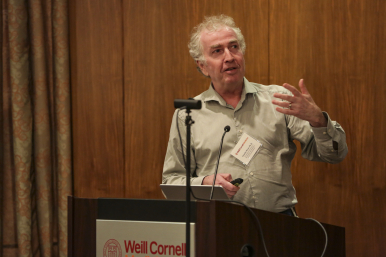
Dr. Tim Ryan
Dr. Tim Ryan, the Tri-Institutional Professor of Biochemistry and Biophysics, and Dr. Teresa Sanchez, an associate professor of pathology and laboratory medicine, both at Weill Cornell, shared their discoveries of potential cures for neurocognitive disorders and how they leveraged accelerator and non-profit funding to move toward clinical applications.
Dr. Ryan’s basic research into brain metabolism led him to discover that Parkinson’s-related mutations disrupt energy production in neurons. The findings pointed toward Terazosin, an established benign prostatic hyperplasia drug that binds to and activates the enzyme PGK1 to boost energy production. Terazosin has shown efficacy across different Parkinson’s disease models. His team is designing new compounds to boost neuronal bioenergetics. Dr. Ryan’s efforts are supported by the SPARK NS program, which provides milestone-based funding, expert advisors from industry and a program manager who checks in with the Ryan Lab regularly and advises on every aspect of drug development. Dr. Ryan’s team has validated a lead compound in preclinical models and developed a second lead. He will continue to receive advice after completing this program, and Cornell retains all intellectual property rights. “We went into this without knowing anything about drug development,” said Dr. Ryan. “Thanks to the collaboration with SPARK NS, we have come pretty far in this process and have been fairly successful.”
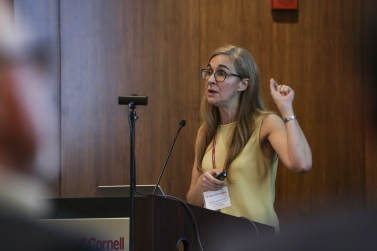
Dr. Teresa Sanchez
Dr. Sanchez investigates the mechanisms underlying cerebrovascular dysfunction in stroke, dementia and sepsis. Sepsis survivors often experience long-term cognitive impairment, for which effective preventive therapies remain limited. Her laboratory has developed a first-in-class, antibody-based strategy targeting a previously underexplored vascular signaling pathway to preserve blood-brain barrier function and limit the entry of harmful blood-derived components into the brain. This preclinical approach holds promise for preventing or mitigating neurological injury and cognitive impairment following sepsis. Her project received funding through the Critical Path Institute’s Translational Therapeutics Accelerator program to support antibody optimization and preclinical validation in addition to collaborations with pharmaceutical companies toward therapeutic development. “As basic scientists, we excel at uncovering disease mechanisms. However, translating those discoveries into therapies requires expertise, resources and partnerships beyond the laboratory,” Dr. Sanchez said. She emphasized Enterprise Innovation's instrumental role in guiding early therapeutic development as well as the importance of securing diverse funding sources toward the ultimate goal of improving patients’ lives.
Recognizing and Nurturing Innovations
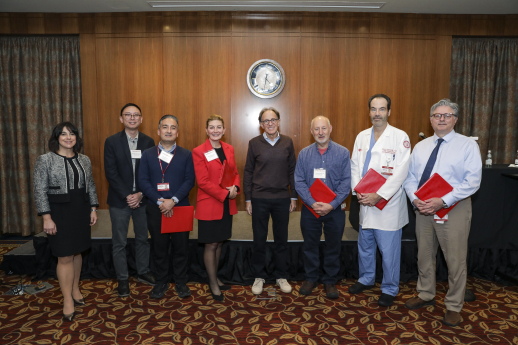
From Left: Dr. Lisa Placanica, Dr. Khanh Pham, Dr. Amir Goldan, Dr. Rache Simmons, Mr. Richard Ruben (Center), Dr. Stephen Kaminsky, Dr. Jason Spector and Dr. Tan Ince.
The symposium also recognized the awardees of the inaugural Catalyst Fund for Innovation, which reimagined and expanded an internal gap fund in 2025 through a gift from Weill Cornell Board Fellow, Richard Ruben. The Catalyst Fund provides milestone-based awards to support Weill Cornell translational research that shows promising commercialization potential with proposals reviewed by industry and venture capital executives as well as pharmaceutical professionals.
Awards covered three development tiers and all major pillars of biotechnology including therapeutics, medical devices, diagnostics, research tools and digital health.
Breakout Award: Existing Weill Cornell intellectual property asset that has received strong feedback and interest from commercial entities.
- Dr. Amir Goldan, associate professor of electrical engineering in radiology, “Neurotwain: Extended Reality Based Virtual Imaging with AI-enhanced Digital Neuro-twinning for Screening of Brain disorders”
Validation Award: Projects with preliminary proof-of-concept but need additional translatable data package for industry collaboration or startup launch.
- Dr. Stephen Kaminsky, professor of research in genetic medicine, “Anti-oxidant Gene Therapy for Dry Age-related Macular Degeneration”
- Dr. Amy Kuceyeski, professor of mathematics in radiology, “Neurosculpt: Shaping Brain Networks with Sensory Stimuli”
- Dr. Jason Spector, professor of surgery, “Tunable Biodegradable Implants via Additive Manufacturing of Fe/Mg Composites”
Selma and Lawrence Ruben Validation Stage Award
- Dr. Tan Ince, professor of pathology and laboratory medicine, “Organoids: A Transformative Approach to Patient-Derived Cell Cultures—Faster, Cheaper and Easier”
- Dr. Rache Simmons, professor of surgery, “Animal Safety Validation Study for Flexible Cavity-Filling Device with Fiducial Markers for Patients Undergoing Lumpectomy”
Proto Award: Earlier projects that need support for proof-of-concept and prototype development
- Dr. Tamatha Fenster, assistant professor of clinical obstetrics and gynecology, “Tamicap: The First Ever Metamorphosis of Passive Menstrual Products into Diagnostic and Therapeutic Powerhouses to Restore Pelvic Health
- Dr. Jeffrey Greenfield (M.D. ’02), professor of neurological surgery, “NeuroNest: A Wireless, Inexpensive and Minimally Invasive Intracranial Pressure Monitor”
- Dr. Khanh Pham (M.S. ’22), assistant professor of medicine, “AI-SCOPE: Artificial Intelligence for Safeguarding against Clostridioides difficile Infections by Optimizing Prescribing of Empiric Antibiotics—A Pilot Study”
Widening the Aperture for Commercializing Science
Dr. Matt Marx, vice provost for entrepreneurship, innovation, and external engagement at Cornell University, closed the symposium by introducing AI tools designed to reduce friction and allow more efficient and cost-effective patent filings, and the ability to better connect investigators to grant opportunities and potential collaborators.
Dr. Marx likened his mission to streamline the translation process at Cornell for the next decade to widening the aperture in photography to let in more light. He is developing a website where AI agents help identify overlooked discoveries, match investigators with relevant funding opportunities and suggest potential co-founders if an investigator is contemplating starting a company. His team is also working on creating a large-scale accelerator for all of Cornell.
"You don't know the exact path to market at the beginning. You may start and stop," said Dr. Marx, echoing the theme of nonlinear translation journey from the fireside chat. "Here at Enterprise Innovation, we're working hard to connect you with the resources you need."

