

When Kiran Abraham-Aggarwal started his undergraduate studies at Cornell’s School of Industrial and Labor Relations (ILR), he assumed it would lead to a career in economic development or perhaps law, like many of his classmates. With an interest in advocacy and policy reform, these disciplines felt like a fit. But then, in his sophomore year, he attended his parents’ class reunion at Weill Cornell Medical College in New York City. Included on the schedule was a tour of the anatomy lab and an opportunity to view a cadaver—a person affected by black lung disease. Abraham-Aggarwal studied the condition in one of his ILR classes, learning about coal miners in West Virginia, but seeing it up close changed his whole perspective.
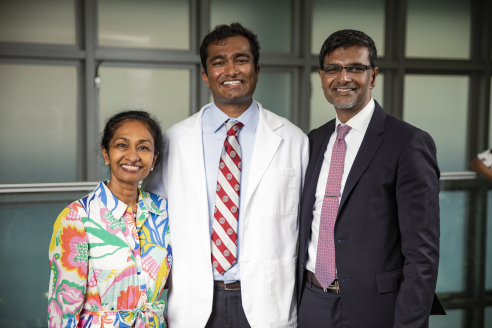
Kiran Abraham-Aggarwal celebrates his new white coat with his parents, Dr. Kavita Aggarwal, M.D. ’96 and Dr. Manoj Abraham, M.D. ’97. To view our full photo gallery, click the picture. All photos: Reece Taylor Williams
“Getting to actually see the condition in person, I thought, ‘Oh my God; I want to be on the patient care side of things,’” Abraham-Aggarwal said. “Healthcare and labor relations intersect in so many ways, and I realized medicine could be my ILR education in action. As a physician I could provide medical care and still advocate for people who need it most at the policy level.”
Abraham-Aggarwal seized opportunities to participate in collaborative research with ILR and Weill Cornell, including work with home health aides. Following graduation, he completed his post-baccalaureate at Goucher College and applied to Weill Cornell Medical College, his top and only choice, continuing the family legacy.
“It’s sort of that full circle moment,” he said. “Weill Cornell was obviously the perfect place for me. And I'm so grateful to be part of an amazing place that values curiosity and collaboration across disciplines.”
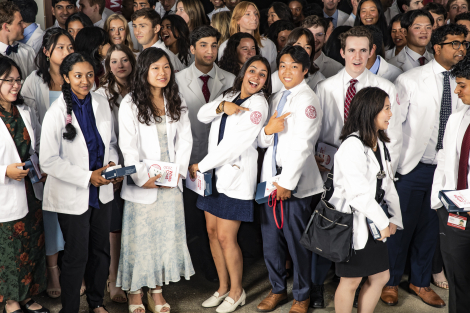
Medical students in the Class of 2030 Aug. 18 during the annual white coat ceremony.
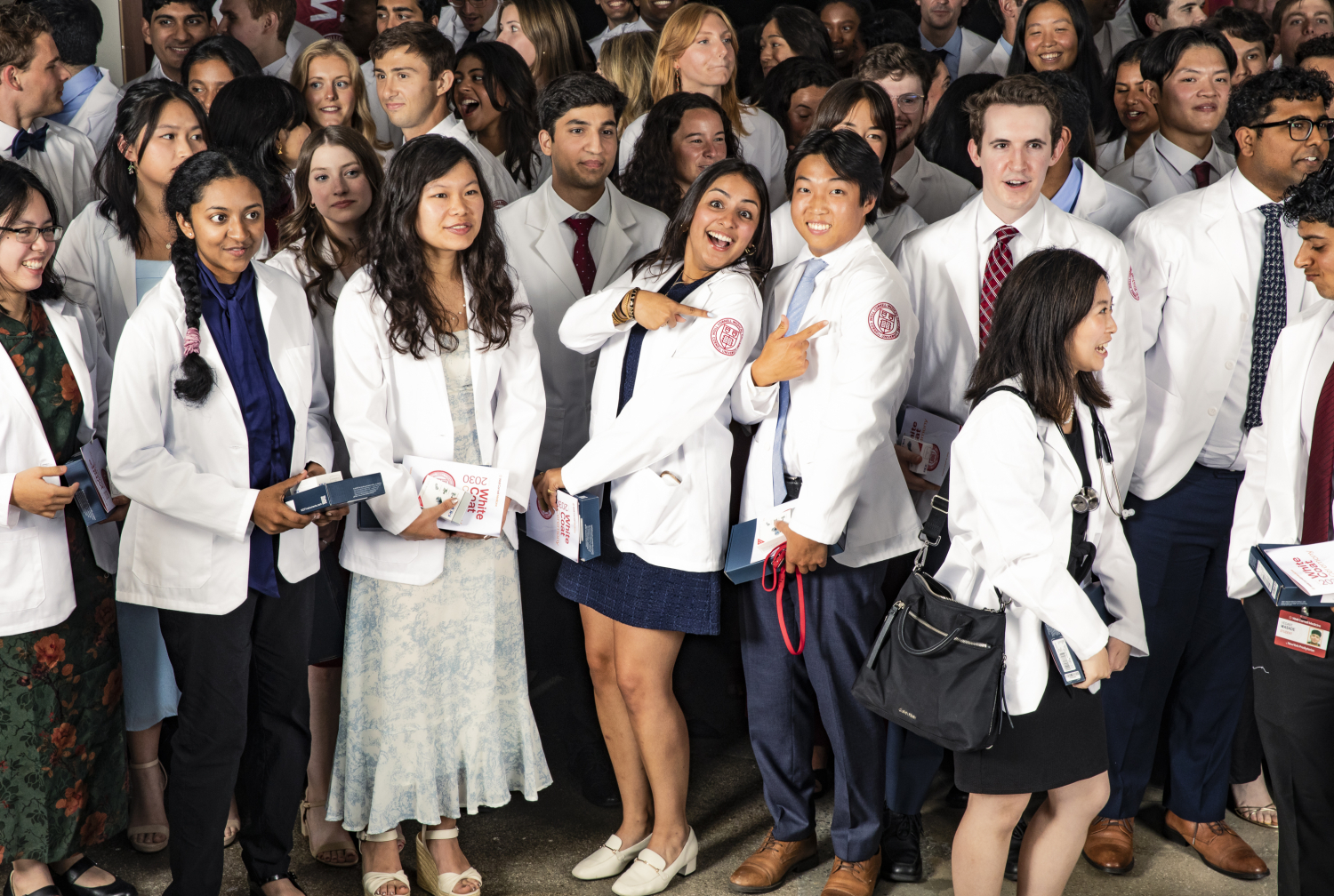
On Aug. 18, Abraham-Aggarwal joined 105 of his fellow first-year medical students in the Class of 2030 at the institution’s annual White Coat Ceremony, officially marking the beginning of their medical education. In front of family and friends at 1334 York Ave., students received their new coats from faculty members, along with stethoscopes provided by the Moss Family Foundation and the Paul F. Miskovitz, M.D. ’75 Stethoscope Fund for Medical Students.
“The white coat is not a symbol of authority; it is a symbol of responsibility. It reminds us that while medicine will continue to evolve, our commitment to the people we serve must remain constant,” said Dr. Joseph Safdieh, the Richard P. Cohen M.D. Senior Associate Dean for Education. “Today, we welcome you into a profession that is both ancient and continually being reinvented. May you remain grounded in the values that define medicine, while boldly embracing the future that lies ahead.”
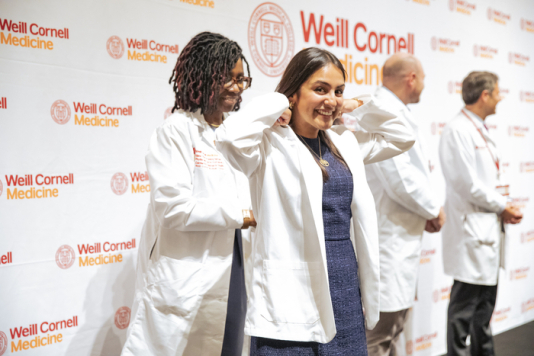
Dr. Joy Howell coats student Raveena Vij during the White Coat ceremony.
“We hope your medical degree will be the beginning of a decades-long journey of self-reflection and growth,” said Dr. Robert A. Harrington, the Stephen and Suzanne Weiss Dean of Weill Cornell Medicine and provost for medical affairs of Cornell University. “We know your compassionate contributions to our community, our fourth mission, will be priceless. We invite you to wear the white coat well, to feel the joy of medicine.”
The Class of 2030 adds to Weill Cornell’s rich and diverse community. Its students attended 41 different undergraduate colleges across 19 states, the District of Columbia and Ontario, Canada. Sixteen have earned master’s degrees and two have doctorates. They were born, lived, studied or worked in over 25 different countries and 60% of the class is bilingual or multilingual. They have collectively contributed to over 60 research publications, and five have participated in NIH-funded research.
In his keynote address, Dr. Leonard Girardi, M.D. '89, chair of the Department of Cardiothoracic Surgery and the O. Wayne Isom Professor of Cardiothoracic Surgery, commended the students for reaching this stage in their journey and offered some words of advice.
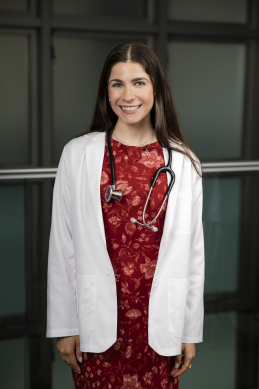
Cassandra Stecker celebrates earning her white coat.
“When you put on those white coats with the red patch today, your efforts, along with Weill Cornell’s support, are the beginning of a career that offers the opportunity to achieve greatness in each and every one of you,” he said. “Four years pass by very quickly so, irrespective of whether you ultimately take care of patients, educate the next generation of students and residents, or perform cutting edge research, please give it your very best each and every day. Study hard, be a little uncomfortable and extend your boundaries.”
For Cassandra Stecker, like Abraham-Aggarwal, the path to medicine was not a straight line. From a young age, the Philadelphia-native always had a passion for history and learning. So, when the time came, she chose a double major in history and Medieval and Renaissance studies at Duke University.
Two years into her undergraduate studies, COVID hit. “I was back home, doing my classes remotely and watching the pandemic unfold around me. Healthcare was at the forefront of everyone’s minds, myself included,” she said. “I really loved what I was studying, but I saw medicine as a way to pair the intellectual curiosity of history and the investigative thinking I enjoyed with more of a real-world tangible impact—something I had been missing. I wanted to help others.”
After graduating, Stecker did a brief stint teaching high school—her original career objective—but couldn’t stop thinking about medicine. She pivoted to the postbaccalaureate premedical program at Bryn Mawr, before finally landing at Weill Cornell Medical College, joining the Class of 2030.
“I think because my path was not completely linear, putting on the white coat feels like the culmination of a lot of little decisions in my life that led up to this moment,” she said. “Not starting over—but starting a new chapter.”
View full White Coat Ceremony video here.

