

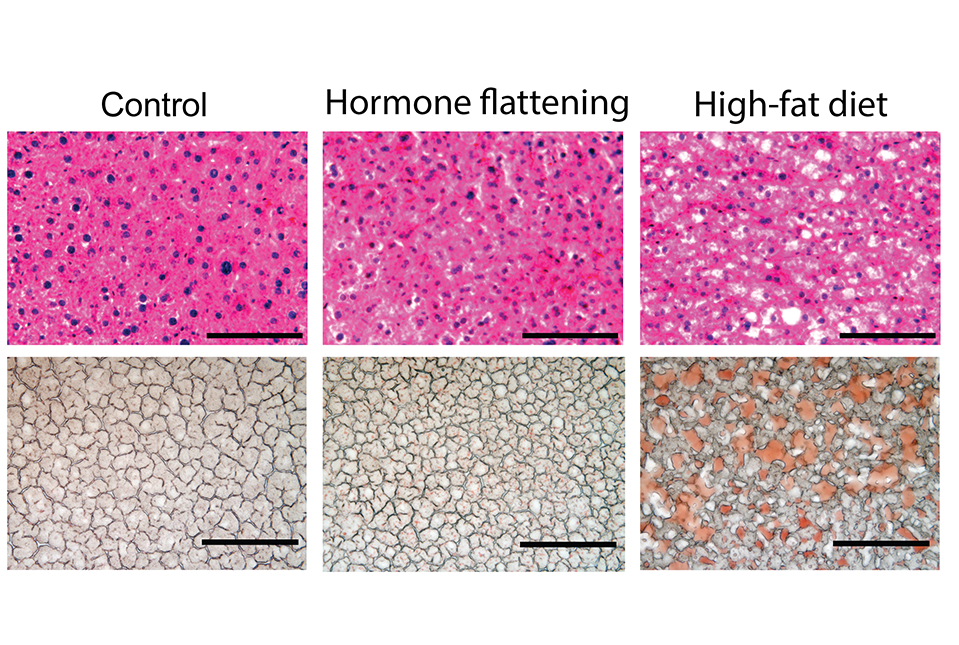
Obesity caused by disrupted stress-hormone rhythms is metabolically very different from obesity caused by a high-fat diet, according to a new preclinical study by Weill Cornell Medicine investigators. The researchers found in mice that glucocorticoid-rhythm disruption concentrates insulin resistance in skeletal muscle while preserving key insulin responses in fat tissue and liver. This allows fat tissue to continue storing lipids, while the liver remains largely protected from the fat accumulation typically seen with high-fat-diet obesity.

Dr. Mary Teruel
In the study, published Sept. 8 in Cell Reports, Dr. Mary Teruel, associate professor of biochemistry at Weill Cornell Medicine, and her team, including postdoctoral associates and co-first authors Drs. Agnieszka Agas and Sanjeev Sharma, separated the effects of hormone timing from diet by independently varying both factors. Mice had either normal or flattened glucocorticoid rhythms and ate either a standard diet or a high-fat diet. Normally, glucocorticoid levels fall during the animals’ rest period and rise around the start of their active period. The researchers flattened the rhythm by raising the low hormone level during rest and blunting the daily peak, without substantially increasing average glucocorticoid levels.
The findings build on a 2022 Cell Reports study from the Teruel laboratory showing that flattening glucocorticoid rhythms caused mice to accumulate large amounts of fat without increased food intake, while maintaining normal blood glucose and relatively little liver fat. The new study explains how that unusual metabolic state is maintained.
“We realized there are two different mechanisms, hormones and diet, making mice obese,” said Dr. Teruel, who is also a member of the Joan and Sanford I. Weill Center for Metabolic Health and the Gale and Ira Drukier Institute for Children’s Health at Weill Cornell Medicine. “This may be occurring in people, too.”
In 30 days, mice on the high-fat diet increased their fat mass about threefold. The glucocorticoid-flattened mice on a standard diet accumulated nearly as much fat, about 2.5 times control levels. Mice exposed to both the high-fat diet and glucocorticoid flattening accumulated the most fat, showing that the two drivers of obesity were largely additive.
Mice in the glucocorticoid-flattened group also lost lean muscle mass, but only during the first week. Lean mass then stabilized and began to increase. Despite becoming profoundly obese, these mice were largely protected from the pathological fatty liver seen in high-fat-diet-fed mice. Their fat was instead preferentially stored in white adipose tissue under the skin and around organs.
“It’s not just how many calories they were eating. The timing of the hormonal signals changed how the body handled those calories and where the energy was stored, which was a bit astonishing to me,” Dr. Teruel said.
Both high-fat-diet-fed and glucocorticoid-flattened mice developed insulin resistance, but it was distributed differently. In the glucocorticoid-flattened mice, insulin resistance was concentrated in skeletal muscle, while fat tissue retained a key response to insulin that suppresses fat release. At the same time, insulin levels rose dramatically. This unusual pattern may help the animals maintain metabolic balance by allowing high insulin levels to keep lipids stored in adipose tissue rather than accumulating pathologically in the liver.
Human studies have linked disruption of the normal daily cortisol rhythm, including higher cortisol when levels are normally low, with obesity and abdominal fat. Altered rhythms have also been reported with chronic stress and shift work. The preclinical experiments allowed the researchers to isolate hormone timing from diet and determine how rhythm disruption changes metabolism.
In the United States, about 40% of adults and about 20% of children have obesity, according to the Centers for Disease Control and Prevention. The findings raise the possibility that diet may not be the only factor shaping obesity. “We’re asking ourselves, is this really just all about the food, or is there something else going on?” Dr. Teruel said. “Have factors like sleep deprivation or stress flattened our normal daily glucocorticoid rhythms?”
While more research is needed, “we should stop treating obesity as one thing,” Dr. Teruel said. “We should stop treating insulin resistance as one thing too. Our preclinical results show that muscle, fat and liver can respond very differently to insulin depending on what is driving the metabolic change.”
Metabolic health may therefore depend not only on how much fat is stored, but also on where insulin resistance develops and whether fat tissue remains able to store lipid rather than releasing it to other organs.
This work was supported in part by the National Institute of Diabetes and Digestive and Kidney Diseases, part of the National Institutes of Health, through grant number DK131432-01A1. Additional support was provided by startup funds from the Drukier Institute and Weill Cornell Medicine.

