

Amid a changing and challenging time for academic medicine, Weill Cornell Medicine is poised to thrive in the coming years, with a planned expansion of its clinical enterprise serving as an engine for overall institutional growth, Dean Robert Harrington conveyed Dec. 16 during his biannual State of Weill Cornell Medicine address.
Weill Cornell, like many academic research institutions nationwide, has navigated financial uncertainty stemming from rapidly changing federal research support. But these challenges also revealed an opportunity to evaluate Weill Cornell’s core strengths—culminating in a plan to create the “academic medical center of the future,” said Dr. Harrington, the Stephen and Suzanne Weiss Dean of Weill Cornell Medicine and provost for medical affairs of Cornell University.
“I know this has been a tough year, but I’m also optimistic about the future,” he said. “And I’m especially optimistic because of the quality of the people that we have working across every domain: clinical, research and education.”
Strategic Clinical Growth
It’s been 19 years since the Weill Greenberg Center, Weill Cornell’s flagship ambulatory care center, opened to patients, ushering in a period of dynamic growth that positioned the institution for clinical excellence.
The new strategic plan, which will guide institutional priorities through 2029, calls for a significant expansion of Weill Cornell Medicine’s clinical care footprint with two major upcoming projects facilitating that growth: the Midtown Clinical Care Center at 575 Lexington Ave. and 1334 York Ave. on the Upper East Side.

Exterior renderings of 1334 York Ave., left, and the Midtown Clinical Care Center at 575 Lexington Ave., right.
“We have two incredible opportunities in the Midtown location and at 1334 York to build our clinical programs,” said Dr. Harrington, noting that clinical care is the economic driver of the institution’s research and education programs. “Not instead of research, but as a complement to it and as a way to really help combine both missions."
The strategic plan builds on the achievements of the We’re Changing Medicine campaign, which surpassed the $1.5 billion threshold a year ahead of schedule. In this first phase, the campaign supported the creation of 53 endowed faculty positions, launched Weill Cornell’s debt-free scholarship program for medical students who qualify for financial aid, and facilitated the construction and opening of the Feil Family and Weill Family Residence Hall.
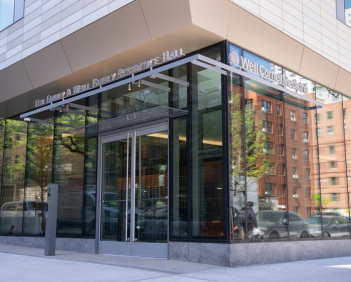
The Feil Family and Weill Family Residence Hall officially opened to students August 2025. Credit: StudioBrooke
The Midtown Clinical Care Center at 575 Lexington Ave. will house top doctors offering clinical care at a convenient location, with multidisciplinary offerings in women’s health, psychiatry, advanced imaging and a variety of other specialties launching in April and December 2026.
After initially securing five floors of 1334 York Ave., the former home of Sotheby's auction house, in 2023, Weill Cornell Medicine converted its 30-year lease into a purchase last October, allowing increased flexibility in future space programming, including plans to offer clinical services on the first two floors.
These two locations will allow the institution to expand and thematically organize its clinical services, providing multidisciplinary care that promotes synergies across Weill Cornell departments. This clinical structure, along with the integration of research and clinical care, establishes what Dr. Harrington envisions as the institution’s path forward.
“If we think about what the academic medical center of the future is going to be, I would propose it’s going to be one that has access to state-of-the art diagnostics and therapeutics,” he said. “There’s going to be patient centricity around everything we do, including in clinical research—we need our patients to be engaged in the research process. Computational biology is going to be really critical to everything we do, that’s going to enable all of this—not just on an individual level but on the populational level.”
Leading Change in Health Care
To realize this vision, Weill Cornell will follow a guiding ethos called CARE, which contains four core tenets: clinical care that improves lives and communities; AI and data science driven across missions; research that fuels innovation; and education that shapes the future.
The strategic plan’s objectives in clinical care include achieving best-in-nation patient and clinician experience; realizing economically sustainable strategic clinical growth, including determining priorities for geographic expansion and identifying new care delivery settings and opportunities; strengthening the partnership with NewYork-Presbyterian; and growing clinical research as a bridge between missions—including increasing point-of-care clinical research activities and use of AI tools to enhance patient care.
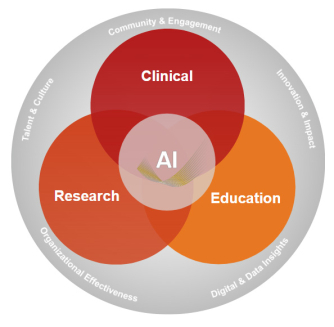
This graphic represents Weill Cornell Medicine's strategic plan, which contains four core tenets: clinical care that improves lives and communities; AI and data science driven across missions; research that fuels innovation; and education that shapes the future.
Research and innovation strategic objectives will focus on diversifying funding towards industry and non-federal sources; maximizing use and efficiency of core facilities, including expanded facilities for data science; advancing opportunities with Weill Cornell Medicine-Qatar, Cornell Tech and Cornell’s Ithaca campus, and Columbia, among other institutions; mentoring, training and developing physician-scientists; advancing strategic institutional faculty recruitment; and optimizing institutional structures to enhance synergy.
Strategic objectives in education include fostering professional identity formation among students; enhancing curriculum by integrating cutting-edge digital skills; expanding educational program collaborations; engaging learners through team science and additional clinical exposure; and an increased focus on educator training, mentorship and recognition of excellence in teaching and scholarship.
“We like to remain hopeful and optimistic, but I’m not naïve,” Dr. Harrington said. “I know there’s a lot of change afoot, but rest assured that we are all paying attention. This is a great place and we want to make it even better, and it’s a great place because of all of you.”
An archival recording of the State of Weill Cornell Medicine address is available for WCM faculty, staff, and students.

