

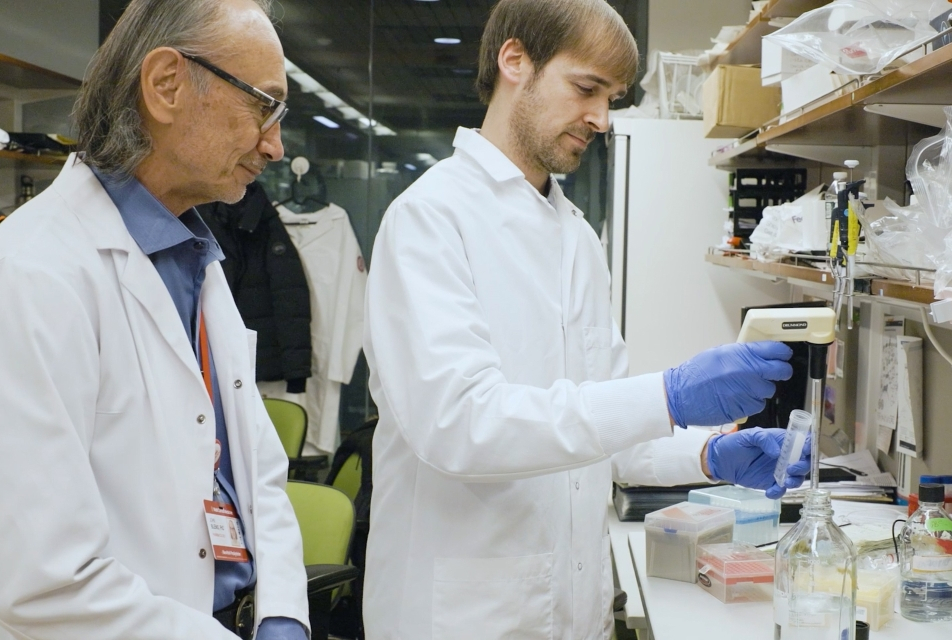
Recently, his lab discovered that low levels of folate, a B vitamin essential for cell growth, can trigger specific genetic changes found in several human cancers, including lung tumors.
“Researchers have known about these genetic changes for many years, but no one knew what caused them,” said Dr. Guillermo Burgos-Barragan, instructor in pharmacology at Weill Cornell, who is co-leading this project. “Our data suggests that folate deficiency is a major contributor to lung cancer development and progression.”
Lung cancer is the leading cause of cancer death in the United States, accounting for about 20% of all cancer deaths. For decades, scientists have known that smoking is the biggest risk factor for lung cancer. Yet, a mystery remains: why do some who have never touched a cigarette develop the disease while some lifelong smokers never do? Drs. Blenis and Burgos-Barragan may have uncovered part of the answer.
They found that mice fed a folate-deficient diet developed more aggressive, faster-spreading lung tumors and had lower survival rates than those on a normal diet. This provides evidence that dietary folate is a potent modulator of lung cancer progression, affecting both metastasis and survival.
“This is more than just a correlation. We have defined a novel mechanism that outlines how genetic changes occur on a molecular level,” said Dr. Blenis, who is also a member of the Sandra and Edward Meyer Cancer Center at Weill Cornell. “Understanding this underlying biology may lead to identification of new drugs and biomarkers for certain cancers.”
More broadly, they established a link between nutrition and specific genetic alterations in cancer, opening new dietary approaches for prevention and treatment. In the future, this may help people at risk of folate imbalance due to diet, genetics, medication or local nutrient deficiencies that arise within tumors. This research, however, is still in the early stages and will require further testing before it can benefit people.
Their work has the potential to change how scientists understand not only lung cancer, but also other cancers that may be linked to metabolism. “This is only the beginning,” Dr. Burgos-Barragan said. “We are exploring how folate and other nutrients might cause or prevent genetic changes across different cancer types. Ultimately, we hope to find ways of preventing the initiation of cancer or halting its progression.”

