

As states reassess Medicaid coverage following recent federal policy changes and the end of pandemic-era protections, researchers are advocating for evidence-based health care policy reform and expanded Medicaid coverage for children. Weill Cornell Medicine’s Department of Pediatrics, the Cornell Health Policy Center (CHPC) and Ariadne Labs are collaborating to launch the Era of the Child Initiative, which supports the design and implementation of effective policies to improve U.S. children’s health.
“We have joined forces because as a country we haven’t prioritized children’s health and the pediatric health care workforce enough,” said Dr. Robert A. Harrington, the Stephen and Suzanne Weiss Dean of Weill Cornell Medicine. “U.S. children face rising rates of chronic conditions like obesity and diabetes, mental health issues and fatal injuries, and they have nearly double the death rate of children in other high-income countries.”
Medicaid is a joint federal and state program that provides free or low-cost health coverage to millions of Americans with limited income and resources. Nearly half of America’s kids, approximately 37 million children, depend on Medicaid for preventive and acute care, yet recent policy changes could undermine the resources essential to raising healthy children. Uninsured rates among children are expected to increase in coming years due to changes from the 2025 One Big Beautiful Bill Act (OBBBA) to the Medicaid program.
Research has shown that Medicaid coverage for kids leads to improved health, educational attainment, better labor force participation and higher income in later life. In addition, three-quarters of U.S. youth ages 17-24 are not eligible for military service due to poor health. Despite the long-term benefits, states are pressured by short fiscal budgets and political cycles, making it difficult to prioritize the investment.
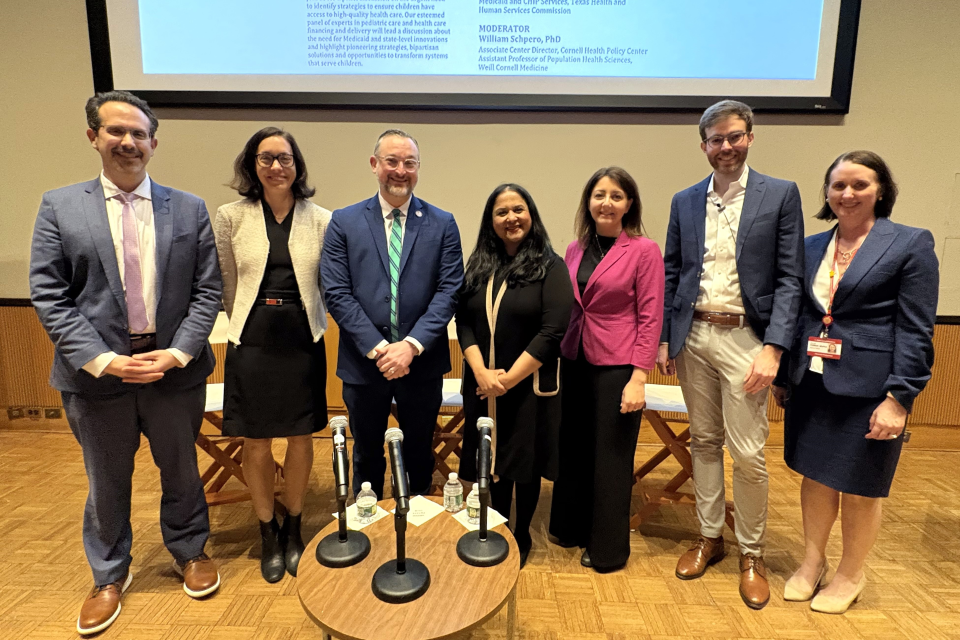
As part of the Initiative to address these issues, a recent panel discussion in Uris Auditorium at Weill Cornell brought together experts in children’s health care policy to discuss the challenges of revamping Medicaid to best meet the needs of children.
Strengthening Children’s Insurance Coverage
Moderator Dr. William Schpero, assistant professor of population health sciences at Weill Cornell and associate center director of CHPC, challenged the expert panel to focus on state level innovation, bipartisan solutions and pioneering strategies to transform the health care system.
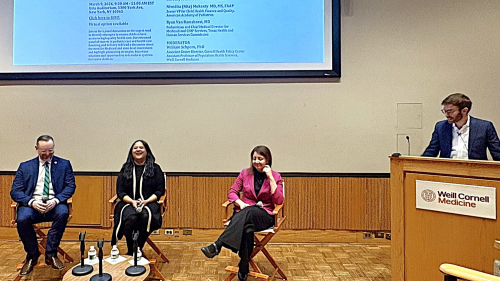
(left to right) Ryan Van Ramshorst, Nivedita Mohanty, Mandy Cohen and William Schpero.
A major obstacle in providing insurance for all children is the funding constraints states operate under, including decreased federal funding. “When advocating for Medicaid investment, we talk about the many valuable societal outcomes, in addition to the pediatric health outcomes,” said Dr. Nivedita Mohanty, senior vice president for child health finance and quality at the American Academy of Pediatrics. “We support universal eligibility and continuous Medicaid coverage from when an infant leaves the hospital until they're 26 to prevent harms that occur when coverage is interrupted.”
Together with funding these programs, identifying appropriate metrics to measure how well Medicaid is working will be necessary. The current quality measurement system could be improved by including metrics of broader societal benefits like school readiness and food security, which are not typically included, Dr. Mohanty said.
“In Texas, we have done surveys trying to measure how successful our programs are in supporting families and enabling parents to work or engage with the community,” said panelist Dr. Ryan Van Ramshorst, chief medical director for Medicaid and CHIP Services at the Texas Health and Human Services Commission. “We need to account for things that matter to families, such as a child's ability to play soccer despite asthma, or caregiver stress and support.”
Furthermore, state-to-state variations in measures hinder large-scale data analysis and the ability to track improvements over time. Another source of variation across states is differences in populations and services covered by Medicaid. States use managed care organizations to run these health insurance plans and coordinate care for patients through a network of doctors and hospitals.
The panel suggested that harmonizing measures across states would allow more effective data analysis.
“I think we need to be bold in what we measure, and we need to hold people accountable, particularly the ones who hold the money, such as the state and managed care companies,” added Dr. Mandy Cohen, a national advisor at Manatt Health and former director of the Centers for Disease Control and Prevention.
Prioritizing Pediatric Providers
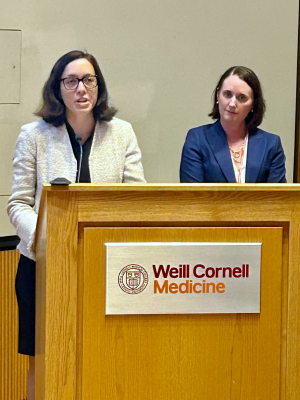
Drs. Beth McGinty (left) and Sallie Permar
Another challenge is a significant pediatric workforce shortfall predicted through 2037, driven by rising demand, high attrition and fewer trainees choosing pediatrics. Pediatricians are among the lowest paid doctors, and pediatric specialists make at least 25% less than doctors who treat adults for their specialty. “This is in part because American insurance focuses on procedures and doesn’t pay for preventive services more common for children, including newborns,” said Dean Harrington.
The current system for reimbursement often leaves providers operating at a financial loss when doing “the right thing.” Without adequate incentives and payment, crucial services for long-term children’s health become financially unfeasible for providers.
“Workforce support and payment reform for comprehensive care is absolutely necessary to preserve access to high quality care and enable provision of services such as integrated behavioral health and addressing social drivers of health,” Dr. Mohanty said.
What’s Different Now
While Medicaid reform has been discussed for decades, the experts agree that we now have the tools and technology to make evidence-based changes. Dr. Cohen sees promise in the powerful generative artificial intelligence (AI) tools that are developing quickly. “They're not ready for prime time yet, but the speed at which they have improved even in recent months is really impressive,” she said. “The challenge lies in harnessing AI's potential to streamline processes and identify unmet needs without exacerbating existing inequalities or creating new ones.”
AI offers the possibility of reducing administrative burden and freeing up resources to invest in the workforce with appropriate regulations guaranteeing safety and accuracy.
“We also need to think about how we can use AI to identify unmet needs for the subpopulation of kids with medical complexity and connect them to care,” said Dr. Van Ramshorst. Reliable data can also help identify kids with greater health risks to allow earlier intervention for the greatest impact.
Next Steps
After the panel discussion, approximately 30 invited experts in the field met in a strategy session focused on reviewing recommendations developed by two working groups. Dr. Beth McGinty, professor of population health sciences at Weill Cornell and co-founding director of the Cornell Health Policy Center, and Dr. Charlene Wong, associate professor in pediatrics at Duke University School of Medicine, led the working group focused on building a pediatric alternative payment model. Dr. Sallie Permar, chair of pediatrics at Weill Cornell, and Lindsey Vuolo, policy director at CHPC, led a working group on strengthening coverage and benefits for children in Medicaid. Participants also discussed communication strategies for building support for changes to Medicaid and brainstormed how to create an ideal financing system to improve pediatric care access and quality.
CHPC is developing next steps from the convening, including development of research and publications, and will continue to engage with those who attended the meeting to build on the momentum and enthusiasm from the event.
Another effort, led by Dr. Schpero, is focused on creating the first comprehensive Medicaid Atlas, using federal data to reveal how Medicaid care and spending vary across the country. By giving policymakers and agencies clearer evidence, the platform aims to guide smarter reforms and improve care for tens of millions of Americans who rely on the program.

