

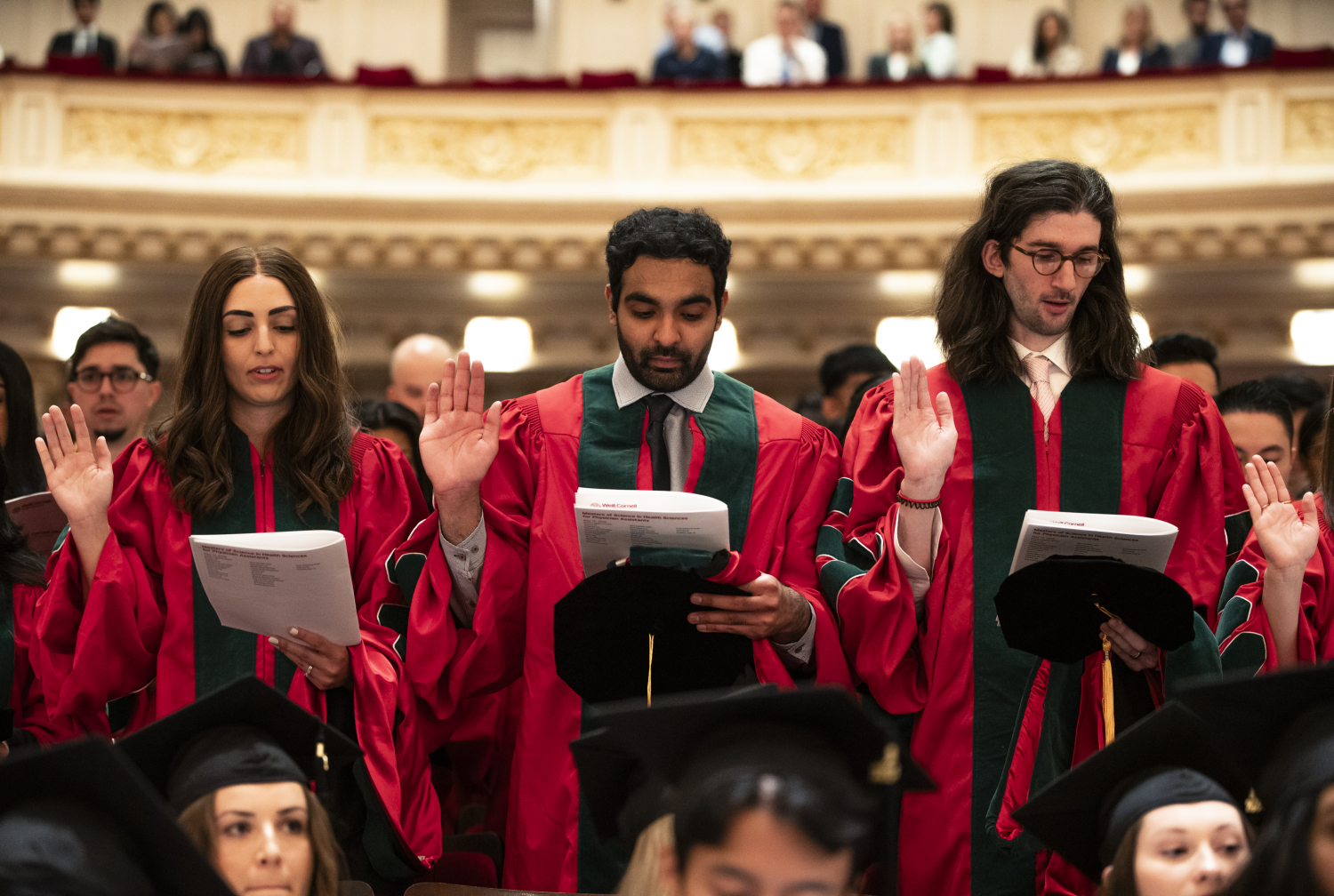
When Dr. Sarah Wozniak was applying to medical schools after completing her undergraduate degree at Rice University, she discovered the Weill Cornell Center for Human Rights, Weill Cornell Medicine’s student-run asylum clinic and the first of its kind at an American medical school.
“I was always very interested in immigration advocacy,” said Dr. Wozniak, whose mother is from Indonesia. “Hearing her story about her pathway to this country, as well as our family’s, just made me really want to learn skills to support people who are going through immigration journeys.”
The WCCHR provides objective forensic evaluations to survivors of persecution or torture who seek asylum in the United States. Inspired by its mission, Dr. Wozniak joined the center as a volunteer in 2022 during her first year at Weill Cornell Medical College and remained active throughout her education, serving as one of the executive directors in her final year.
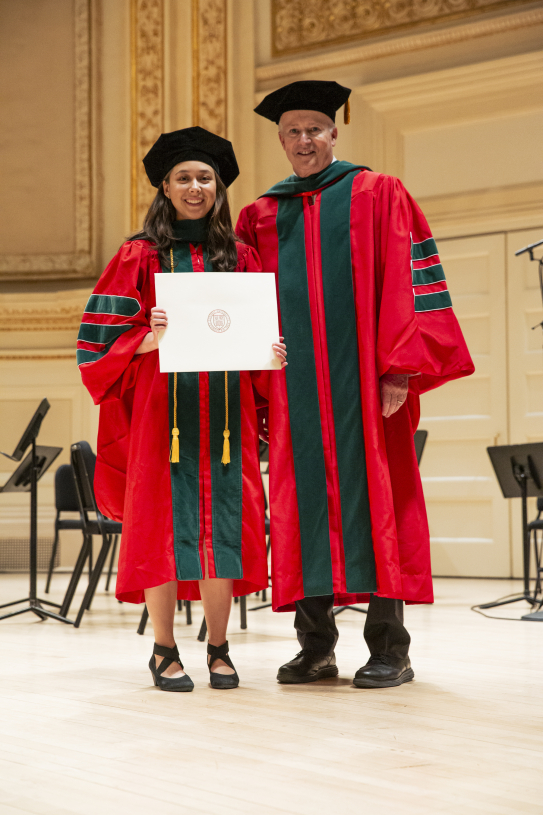
Dr. Sarah Wozniak, left, poses with Dean Robert A. Harrington May 14 after crossing the Perelman stage at Carnegie Hall during Commencement. All photos: Reece Taylor Williams
“I found it to be the most meaningful part of my experience here, other than all the incredible people I met,” said Dr. Wozniak, who will be pursuing her residency in psychiatry at UCLA. “Helping with asylum evaluations—along with my natural curiosity in learning about people’s life experiences—was a way to directly use the skills that we’re developing as emerging physicians to help someone work towards a safe and healthy life, with the human rights every person should have.”
“It just reminded me of why I wanted to go into medicine in the first place,” she said.
Dr. Wozniak was among 136 expected graduates of Weill Cornell Medical College – 108 medical doctors and 28 physician assistants – in the Class of 2026 who received their degrees from Weill Cornell Medicine during the institution’s annual commencement ceremony May 14 at Carnegie Hall. Graduates of Weill Cornell Graduate School of Medical Sciences were honored the same day, receiving their diplomas in a separate ceremony in the afternoon.
Cornell President Michael I. Kotlikoff joined Dr. Robert A. Harrington, the Stephen and Suzanne Weiss Dean of Weill Cornell Medicine and provost for medical affairs of Cornell University, in conferring degrees on the graduating students, who received their diplomas on stage in front of an energetic crowd of cheering classmates, family and friends.
In his address, Dr. Harrington emphasized the value of personal stories: stories that shape your career, change your profession and support our society, he said. “Because stories have the power to connect you to the people you will serve.”
He urged graduates to think beyond their own experiences and lean on and learn from colleagues and classmates. “Your degrees are all hard-won achievements and rooted in your values, yet your medical career is not just your story,” he said. “Rarely do doctors and physician assistants go it alone. This is a profession for adaptable, collaborative team players.”
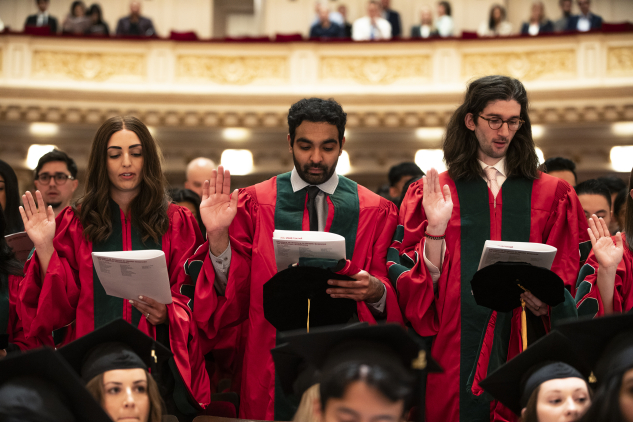
Medical graduates of Weill Cornell Medical College recite the Hippocratic Oath May 14 during Commencement.
He also stressed the importance of listening to patients’ stories, regardless of who is being treated. “It’s a clinician’s honor to be trusted with these narratives.”
With their formal education behind them, members of the Class of 2026 will now embark on residencies, fellowships, and other clinical and health care roles, as they advance to careers as physicians, physician assistants and leaders in medicine.
Connecting the past to the present, President Kotlikoff reflected on Cornell’s history and the role of Weill Cornell Medicine, highlighting the mission of founder Ezra Cornell to establish an institution, “where any person can find instruction in any study.”
“The idea that individuals from different backgrounds, different cultures and different viewpoints could work together was a radical idea in 1865,” said President Kotlikoff. “But it has, of course, proven to be the essential strategy underlying successful modern medicine and the delivery of equitable and excellent healthcare.”
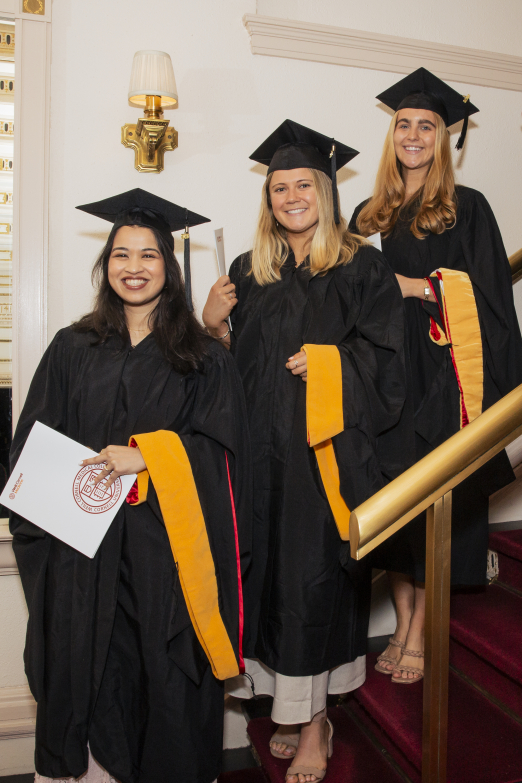
Physician assistant graduates line up May 14 during Commencement at Carnegie Hall.
“From the bench to the bedside, the idea that all members of the team have agency, and anyone should have access, has become the model for academic medicine,” he added.
Echoing Dr. Harrington’s theme, Dr. Daniel Anisfeld Tay, this year’s medical student speaker, shared how he connected with a psychiatric patient by helping her learn Mandarin Chinese—inspired by his passion for Chinese poetry translation. He reminded his classmates that they have special gifts, “gifts that can help us transcend our textbook learning to infuse patient care with humanity and attune to each individual’s needs and aspirations.”
“Remember that hope and doubt—these are not antagonists of one another,” said Dr. Tay, who will be doing his residency in psychiatry. “Our capacity to experience doubt and our willingness to listen to expressions of doubt can help lay a foundation for authentic trust that points the way to hope.”
Physician assistant student speaker Veerali Patel addressed the feelings of uncertainty many of her fellow graduates may be experiencing, urging them to embrace the challenges and “uncomfortable moments” that lie ahead. “Because uncomfortable usually means we’re growing, learning and stepping into something bigger than we were before,” she said.
“So, if there's one thing we take with us, let it be this: Don’t run from those moments. Lean into them,” said Patel, who will remain at Weill Cornell and NewYork-Presbyterian for an emergency medicine residency for physician assistants. “Trust that you’re capable, even when it doesn’t feel like it yet. Because if these past few years have shown us anything, it’s that we are.”

