

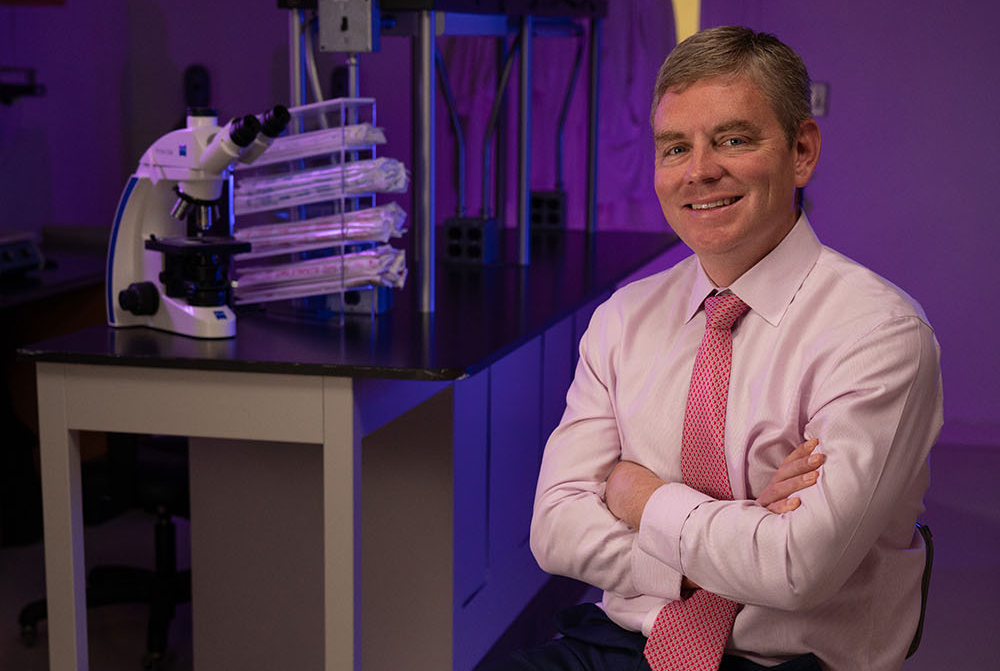
New York (July 9, 2026)—Dr. Timothy R. Donahue, a distinguished surgeon-scientist specializing in pancreatic cancer, has been appointed chair of the Department of Surgery at Weill Cornell Medicine and surgeon-in-chief at NewYork-Presbyterian/Weill Cornell Medical Center, effective Sept. 1.
Building on the academic medical center’s long history of surgical excellence, Dr. Donahue will focus on developing multidisciplinary programs that align patient care, research and education while fostering collaboration and discovery across the two institutions. He is particularly excited about integrating translational and clinical research into surgical care and leveraging cutting-edge technologies, including artificial intelligence, to expand access to the highest quality and most innovative care across Weill Cornell Medicine and its affiliated NewYork-Presbyterian campuses on the Upper East Side, Lower Manhattan, Brooklyn and Queens.
A leading pancreatic cancer surgeon-scientist, Dr. Donahue was recruited from the David Geffen School of Medicine at UCLA, where he served as executive vice chair of the Department of Surgery, chief of the Division of Surgical Oncology and medical director for cancer services across the health system. He succeeds Dr. Fabrizio Michelassi, who has led the department since 2004.
“Dr. Donahue is a preeminent oncologic surgeon and leader whose clinical practice is grounded in the belief that surgical observations and scientific discovery together catalyze the most advanced treatments and therapies,” said Dr. Robert A. Harrington, the Stephen and Suzanne Weiss Dean of Weill Cornell Medicine and provost for medical affairs of Cornell University. “His stewardship of our surgical enterprise will continue its legacy of excellence while ensuring that all New Yorkers have access to next generation treatment paradigms.”
“Dr. Donahue is a renowned surgeon-scientist whose commitment to delivering the highest quality care to patients, building multidisciplinary programs and driving medicine forward makes him the ideal choice to lead surgery at NewYork-Presbyterian and Weill Cornell Medicine,” said Dr. Brian G. Donley, president and chief executive officer of NewYork-Presbyterian. “His ability to bring together clinicians, scientists and educators to accelerate discovery and improve patient outcomes will strengthen our mission to create a healthier future for all.”
Building on Excellence
Over the past two decades under Dr. Michelassi’s leadership, the Department of Surgery at Weill Cornell Medicine and NewYork-Presbyterian has tripled its faculty, doubled its surgical volume and expanded its footprint throughout New York City.
“I’m excited to maintain and build on Dr. Michelassi’s extraordinary achievements and the department’s more than century-long reputation for surgical excellence and innovation,” Dr. Donahue said. “The operating room represents one of the most powerful engines of discovery in medicine. Every operation creates an opportunity to better understand surgical diseases and improve how we diagnose, treat and care for patients. My vision is for the Department of Surgery to serve as a catalyst for collaboration, bringing together clinicians, scientists, engineers, educators and trainees to advance patient care, accelerate discovery and train the next generation of leaders in academic surgery.”
Dr. Donahue noted that the department is well-positioned to play a transformative role in the future of healthcare, citing Weill Cornell Medicine’s outstanding educational programs, the scientific strengths of the Sandra and Edward Meyer Cancer Center; and its affiliation with NewYork-Presbyterian as major advantages. He also highlighted the institution’s strong collaborations across Cornell University and with Columbia University, Memorial Sloan Kettering Cancer Center, The Rockefeller University and Hospital for Special Surgery.
“We are not only going to deliver state-of-the-art care, but also define what the next generation of state-of-the-art care looks like,” he said. “By aligning our clinical, research and educational missions, we can create an environment where innovation thrives, discoveries move more rapidly to patients and every member of the team has an opportunity to contribute. I’m incredibly excited about what we are going to accomplish together.”
For example, he plans to work with Cornell Duffield College of Engineering and Cornell Tech to develop an artificial intelligence program that supports research, education and clinical care throughout the department.
A Thematic Approach to Surgical Care
Working with the leaders of the department’s 13 divisions, Dr. Donahue will help establish multidisciplinary programs that align the department’s clinical, research and educational missions. These programs will bring together surgeons, medical specialists, scientists, engineers, nurses, advanced practice providers, operational leaders and trainees around specific diseases and patient populations, creating new opportunities to improve outcomes, advance discovery and develop innovative models of care.
“We need to do what's best for our patients and continually rethink how we deliver care,” Dr. Donahue said. “The most successful academic departments are those in which outstanding patient care, innovative research and education reinforce one another. When those missions are aligned, they create an environment where collaboration flourishes and new discoveries can rapidly improve the lives of patients.”
In collaboration with Dr. Jedd Wolchok, the Meyer Director of the Meyer Cancer Center, Dr. Donahue aims to establish a dedicated surgical oncology program that will strengthen the cancer center’s efforts. He also plans to build on the department’s ongoing efforts to reduce inequities in care across the communities it serves, with a particular focus on breast and gastric cancer.
Another priority will be supporting the department’s educational mission and supporting its nationally recognized surgical training programs. Dr. Donahue emphasized that the two years of dedicated research time already built into the general surgery program are critical to training future leaders in academic surgery.
“We need to train the next generation to be exceptional clinical surgeons, while also equipping them with the scientific skills, intellectual curiosity and collaborative mindset needed to lead the future of medicine,” he said. The surgeon-scientists, educators and innovators we train today will define the field for decades to come.”
About Dr. Timothy R. Donahue
Dr. Donahue is an internationally recognized pancreatic cancer surgeon-scientist whose work focuses on translating observations from patient care and discoveries in the laboratory into more effective therapies. His research program studies the interaction between cancer and the immune system, with a particular emphasis on developing novel immunotherapic strategies for pancreatic cancer. Through close integration of clinical care, translational research and laboratory investigation, his work has helped identify new mechanisms of treatment resistance and informed the development of innovative therapeutic approaches currently being evaluated in patients.
“It’s a perfect example of how surgeon-scientists can use clinical observations and translational research to develop better therapies for patients,” he said.
Dr. Donahue earned his bachelor’s degree from Northwestern University in 1998 and his medical degree from Northwestern’s Feinberg School of Medicine in 2002. He completed his residency at UCLA Medical Center in the Department of Surgery in 2009 and subsequently joined the faculty at the David Geffen School of Medicine at UCLA. He rose through the academic ranks to become a full professor of surgery, with a joint appointment Molecular and Medical Pharmacology.
During his tenure at UCLA, Dr. Donahue held numerous leadership positions, including executive vice chair of the Department of Surgery; chief of the Division of Surgical Oncology; director of the UCLA Agi Hirshberg Center for Pancreatic Diseases; and medical director of cancer services at UCLA Health. He has also served as the program director for the General Surgery Residency Training Program.
As a surgeon-scientist and academic leader, Dr. Donahue is known for building multidisciplinary programs that align clinical care, research and education around the needs of patients. His leadership has focused on fostering collaboration across specialties, accelerating scientific discovery and creating opportunities for trainees and junior faculty to succeed.
Dr. Donahue has published more than 150 publications, served as principal investigator on more than 20 research grants, and has maintained continuous funding from the National Institutes of Health throughout nearly his entire academic career. He is a three-time recipient of UCLA’s Golden Scalpel Award for Most Outstanding Teaching in the Department of Surgery and also received the Dean’s Award for Excellence in Teaching from the David Geffen School of Medicine. Nationally, he served as president of the Society of University Surgeons, chair of the Surgical Research Committee for the American College of Surgeons, and has participated on numerous grant review panels for both national foundations and the NIH.
Weill Cornell Medicine
Weill Cornell Medicine is committed to excellence in patient care, scientific discovery and the education of future physicians in New York City and around the world. The doctors and scientists of Weill Cornell Medicine — faculty from Weill Cornell Medical College, Weill Cornell Graduate School of Medical Sciences, and Weill Cornell Physician Organization — are engaged in world-class clinical care and cutting-edge research that connect patients to the latest treatment innovations and prevention strategies. Located in the heart of the Upper East Side’s scientific corridor, Weill Cornell Medicine’s powerful network of collaborators extends to its parent university Cornell University; to Qatar, where Weill Cornell Medicine-Qatar offers a Cornell University medical degree; and to programs in Tanzania, Haiti, Brazil, Austria and Turkey. Weill Cornell Medicine faculty provide exemplary patient care at NewYork-Presbyterian/Weill Cornell Medical Center, NewYork-Presbyterian Westchester Behavioral Health Center, NewYork-Presbyterian Lower Manhattan Hospital, NewYork-Presbyterian Queens and NewYork-Presbyterian Brooklyn Methodist Hospital. Weill Cornell Medicine is also affiliated with Houston Methodist. For more information, visit weill.cornell.edu.
NewYork-Presbyterian
NewYork-Presbyterian is one of the nation’s most comprehensive, integrated academic healthcare systems, encompassing 10 hospitals and nearly 350 locations including primary and specialty care clinics and medical groups with world-class doctors from Columbia and Weill Cornell Medicine, and an array of telemedicine services.*
A leader in medical education, NewYork-Presbyterian Hospital is affiliated with two renowned medical schools, Columbia University Vagelos College of Physicians and Surgeons and Weill Cornell Medicine. This collaboration means patients have access to the country’s leading physicians, the full range of medical specialties, latest innovations in care, and research that is developing cures and saving lives.
Founded 255 years ago, NewYork-Presbyterian Hospital has a long legacy of medical breakthroughs and innovation, from the invention of the Pap test to pioneering the groundbreaking heart valve replacement procedure called TAVR.
NewYork-Presbyterian’s 45,000 employees and affiliated physicians are dedicated to providing the highest quality, most compassionate care to New Yorkers and patients from across the country and around the world.
For more information, visit www.nyp.org and find us on Facebook, Instagram, LinkedIn, Pinterest and YouTube.
* In collaboration with physicians from ColumbiaDoctors and Weill Cornell Medicine, NewYork-Presbyterian provides care at 450+ locations.

