

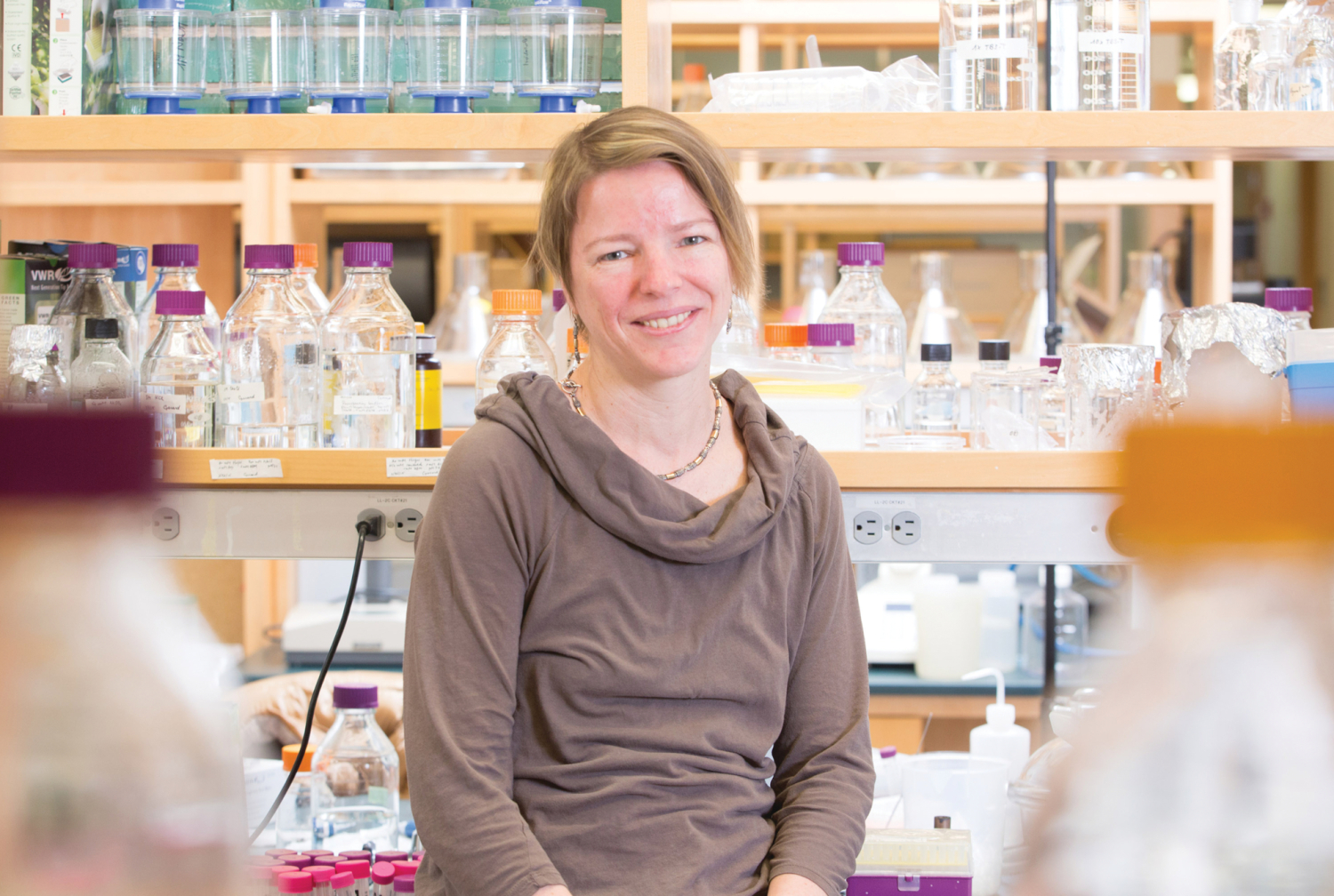
Dr. Olga Boudker, professor of biochemistry and biophysics at Weill Cornell Medicine, has been elected as a member of the American Academy of Arts and Sciences.
The academy, one of the United States’ oldest honorary societies, was chartered during the American Revolutionary War to recognize Americans with significant accomplishments, and to harness their talents for the benefit of the young country. Among the first elected members was George Washington; other inductees have included Benjamin Franklin, Albert Einstein, Carl Sagan and Margaret Mead. This year, the academy elected a total of 252 new members from the sciences, the arts, business and academic administration.
“I already feel so privileged just being able to do science as my daily job, so to receive this public recognition is really an amazing honor and joy for me,” Dr. Boudker said.
Dr. Boudker studies the structures and workings of proteins called membrane transporters. These tiny bio-machines are specialized by evolution to pull specific molecules into the cell, or push them out, to support cellular functions. Glutamate transporters on neurons, for example, play a crucial role in animal biology by rapidly clearing glutamate neurotransmitter molecules from synapses, the tiny spaces where chemical signals cross from one neuron to another. In so doing, these transporters recycle glutamate, clear the way for the next signal, and prevent glutamate from harming synapses. Their functioning is highly relevant to human health: Transporter failures that allow toxic glutamate buildup have been implicated in epilepsy, Alzheimer’s disease, Parkinson’s disease and the brain-cell destruction that occurs after strokes.
Dr. Boudker is known especially for her discovery of a key detail of how glutamate transporters work, an “elevator” mechanism that has since turned up in a broad range of other transporter types.
The advanced techniques her lab uses to study transporters include low-temperature (“cryo-“) electron microscopy for the direct imaging of transporter structures, and methods based on exotic physics, such as Förster Resonance Energy Transfer (FRET) imaging, to track the high-speed motions of transporter subunits.
“The movements of molecules at this scale are highly dynamic and probabilistic, and so my work is rooted very deeply in the thermodynamic principles that govern such behavior,” Dr. Boudker said.
She emphasized that her work has always been a team effort.
“One doesn’t do science alone, and the team I work with in my lab makes the process of science fun,” she said.
Dr. Boudker was elected to the National Academy of Sciences in 2022 and has been a Howard Hughes Medical Institute Investigator since 2015.
Cornell President Michael I. Kotlikoff and faculty members Cathy Caruth, Class of 1916 Professor in the Department of Literatures in English and professor of comparative literature in the College of Arts and Sciences, and Francesca Molinari, the H.T. Warshow and Robert Irving Warshow Professor in Economics, were also among the academy’s inductees this year. A formal induction ceremony will be held this October in Cambridge, Mass.

