

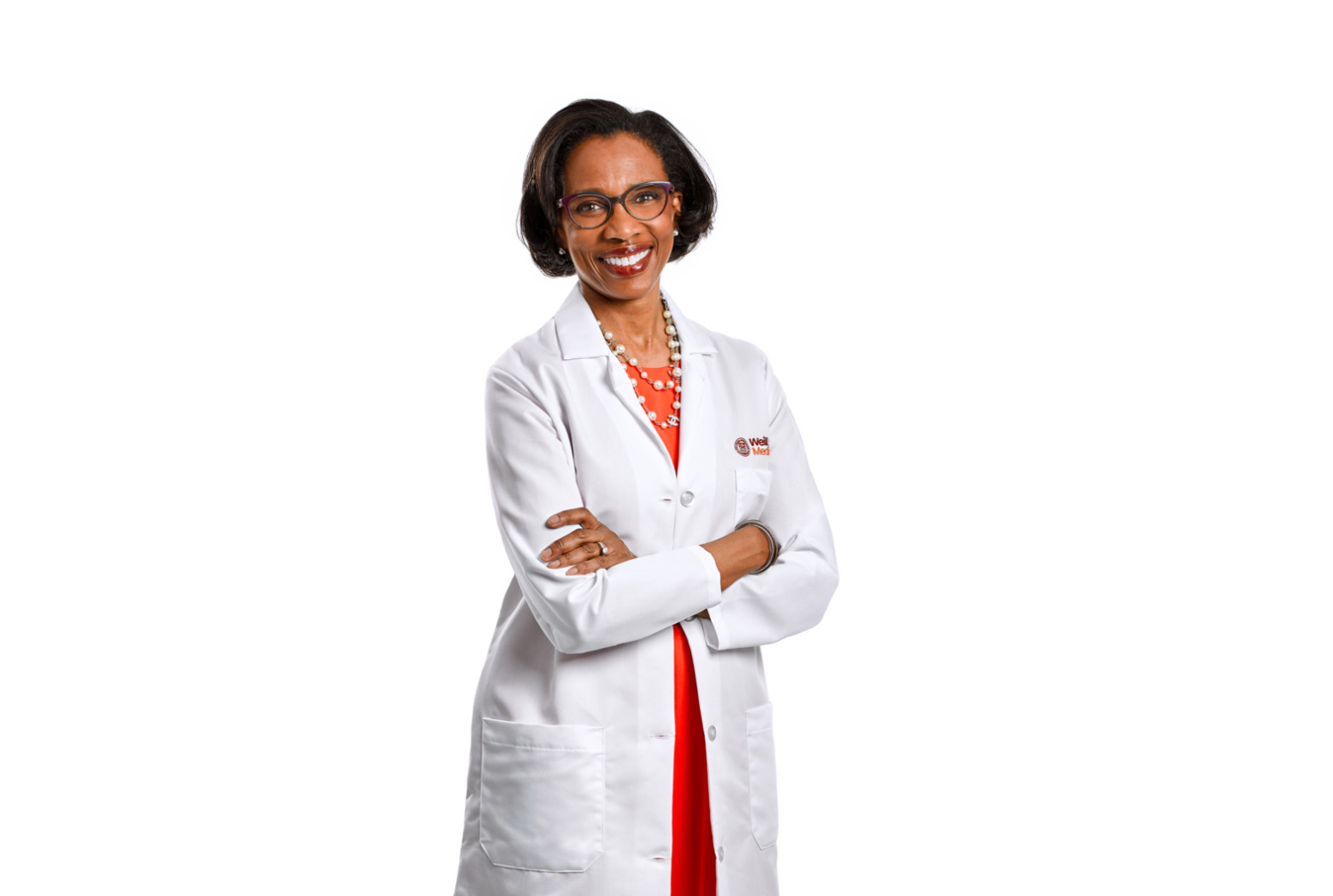
To Dr. Laura Riley, Weill Cornell Medicine’s prowess in caring for women from birth to adulthood is the institution’s best kept secret.
“Weill Cornell is uniquely positioned to provide exemplary care to women, helping them live longer and healthier, and creating evidence for treatment and prevention,” said Dr. Riley, chair of the Department of Obstetrics and Gynecology and the Given Foundation Professor in Clinical Obstetrics and Gynecology. “We need women to know what we can do for them and expand those offerings—because that's what they deserve.”
That is precisely what she aims to do as Weill Cornell’s inaugural executive director for women’s health. This new role, which complements her position leading obstetrics and gynecology, will enable her to unify, coordinate and drive new paradigms for women’s health care across medical specialties. She will leverage multidisciplinary and cross-institutional collaborations to spark new lines of scientific inquiry into women’s health, and more clearly elucidate women’s biological and physiological differences in the medical student and physician assistant curriculum.
“Dr. Riley is a demonstrated leader in the women’s health space who has a natural ability to build relationships and nurture faculty across all our missions,” said Dr. Robert A. Harrington, the Stephen and Suzanne Weiss Dean at Weill Cornell Medicine and provost for medical affairs of Cornell University. “Her exemplary leadership skills and strong institutional commitment to the role make her a fantastic choice to unify and strengthen our women’s health care offerings.”
We sat down with Dr. Riley to learn more about her new role and the importance of applying a holistic approach to women’s health care.
Clinicians and scientists—and our society writ large—have historically applied a one-size-fits-all approach to research and patient care. What have we learned about women's biology and physiology recently to challenge that paradigm?
I would say it's been in the last 10 years or so where, in my subspecialty, we started to finally understand that pregnancy is a window to future health. At first, it was just a phrase. Now it's a well-known situation. I'll give you an example: Women who have high blood pressure complications of pregnancy or gestational diabetes are at increased risk of having chronic hypertension, lipid disorders, cardiac issues and type two diabetes as they age. So if you're 30 years old and you've had a pregnancy with any of these complications, it's critical for us to follow you after that, even as early as one to two years after your delivery, to be sure that your health is optimized for the future. And that's just one example of the crucial need for cardiology, endocrinology and obstetrics to collaborate and improve long term health. In addition, there are so many questions to be answered. And I think the fact that women live longer and need to live healthier is really what should be pushing us to ask the questions, find the evidence and determine how to apply the answers to improve care.
Women's health is often generalized as and limited to reproductive health. Why is it important to examine women's health care in a holistic way?
Even if you are that person who's going to have children and have several pregnancies, it's a really finite period of time. There’s a tremendous amount of preventative care as well as treatment that needs to happen throughout your life. And then there's lots of women who are not going to have children but may still have gynecologic and other medical issues that require long-term care.
We also know that women are more than just their GYN organs. Our heart disease is different. We are more likely to suffer from autoimmune diseases. There's all sorts of physiologic differences. And then pregnancy has different physiologic changes. Even if you just think about young girls and sports, they have different injuries. Our understanding of what differences exist and why is critical to ultimately realizing how that impacts their later life. And certainly, women live longer. We have a physician at Weill Cornell whom I absolutely adore, Dr. Sonja Blum. She does a lot of research on brain health, screening for brain fog and things that happen to the brain during menopause or midlife. And I've always said to her, ‘I wish I had known 20 years ago that I could have done something about it.’ What we should be able to offer to people as scientists, as caregivers, is what can you do to mitigate what may just happen because of genetics or the environment or whatever the issue is. Are there things that we can do to make it better or hold it off longer?
With that backdrop, what is your vision for integrating women's health here at Weill Cornell?
I try and think about it across our mission to care, discover and teach. With clinical care, the topic is access. We know that people may need, say, a cardiologist, or you may need bone or brain health. Getting access to those specialists is not easy at Weill Cornell because we just don't have tons of them. But the question is whether we can do a better job defining who really needs the subspecialist.
Are there models of care that would allow us to take care of more women? Do we think more of taking a team approach to care—I call them prevention teams—where you have a nurse who does education and administers validated screening questions, then a nurse practitioner who can take a look at you and tell you, ‘Oh, everything looks good.’ And then when there's something off, that's when you go to the specialist. I think the other thing around clinical care and access is that we know that so many people need mental health care. We need to figure out different models of care that provide mental health to those who are in need.
As you had said in your last question, I think it's important for people just at every aspect of their medical education to understand that women are different from men. It's a little like kids are not small adults when it comes to medicine. I was with a medical student not that long ago and we were talking in the clinic; we were doing obstetrics and I could tell he didn’t want to do a pelvic exam. His interest was in orthopedics. But then we talked about the fact that guess what? Girls have different sports injuries than boys do. What do you think that's related to? Is it estrogen-related? So I think that from an education standpoint, it's important that no matter what specialty you are attracted to, you understand that the biology, physiology may be different in women. One of the things that I hope to do in this position is work with Dr. Erika Abramson [the Gertrude Feil Associate Dean of Curricular Affairs] to strengthen the curriculum so that there’s more in-depth education about these differences for both for the MDs and the PAs.
And then in terms of research, I think there's definitely a huge opportunity for clinical research, because we are different and our needs are different. Translational research gives us so many critical answers, basic to translational to the clinical—it’s super important to apply all of those areas of scientific inquiry to women’s health where there has been minimal investment thus far.
How might we leverage our relationships with Cornell's Ithaca campus, Cornell Tech and other collaborators to catalyze new discoveries and treatment opportunities around women's health?
I think that we're in a unique position that other institutions aren’t in. There's so much incredible work happening at Cornell’s Ithaca campus. I can tell you in my department, there's a few doctors at NewYork-Presbyterian Brooklyn Methodist Hospital who work with the engineering students up at Ithaca. And we have a relationship as well with some of the people who are coming up with medical devices specifically for women. And so the whole area around innovation is something that I think Cornell could lead in because of the existing talent. There's Cornell Tech, Cornell’s Ithaca campus, Weill Cornell Medicine…the more we collaborate, the easier it is to take those clinical questions and figure out what we can and should be doing to improve health care for women.
The other area that I am personally interested in is working with the Cornell Health Policy Center that is run by Dr. Beth McGinty and Colleen Barry. Health care can’t change until you can finance it and make it sustainable. That definitely involves the ability to impact what the government is doing and be able to be in those conversations.
I think stronger collaborations between all of the different schools and institutes will move women's health along faster and allow us to more comprehensively impact women's health in a positive way.
Women's health is multidisciplinary. How do you envision unifying and coordinating these cross-cutting activities across departments and divisions, and extending that work beyond our Upper East Side campus?
Looking at my department, I think we've done a good job trying to use the resources across the different hospitals in Brooklyn, Queens, Lower Manhattan and 68th Street, and part of that has been making sure that we have a rich and diverse faculty at all of those places. That allows us to bring patients in. The trick is now to make sure that we take good care of them beyond their OBGYN needs and involve internal medicine, cardiology, endocrine, brain health. I think the way to do that is for us to believe in the mission to take care of women holistically.
In just a few weeks, some of our clinical floors at 575 Lexington are coming online, including OBGYN. How do you envision our clinical expansion in Midtown to affect your work here?
I'm hoping that the Midtown location is our first foray into a hub. It's an opportunity to co-locate several specialties, which is one way of bringing us together. And the nice thing about 575 Lex is that it's going to have mental health on a floor. It's going to have OBGYN and pelvic health, internal medicine and primary care. It's going to have an amazing radiology suite that offers premier breast health. It's going to have clinical research on a floor. So it's going to be nice to have a lot of the things co-located, and then it'll also allow us to think about how to create access via telehealth and workflows that get people in faster for the things that are housed separately. I’m really excited about what 575 Lex can bring for us and for our patients. And my feeling is what we can't do at 575 Lex, we will eventually get done at 1334 York Ave. We got this.
Women's health care is at a watershed moment in this country. Why is it important that we drive national dialogue around improving women's health?
Because it hasn't been done well in the past, and I think that we've just been silent for too long. And so now we're left with just a lot of questions and not a lot of answers, yet a huge population of people who are aging. And we deserve better.

